
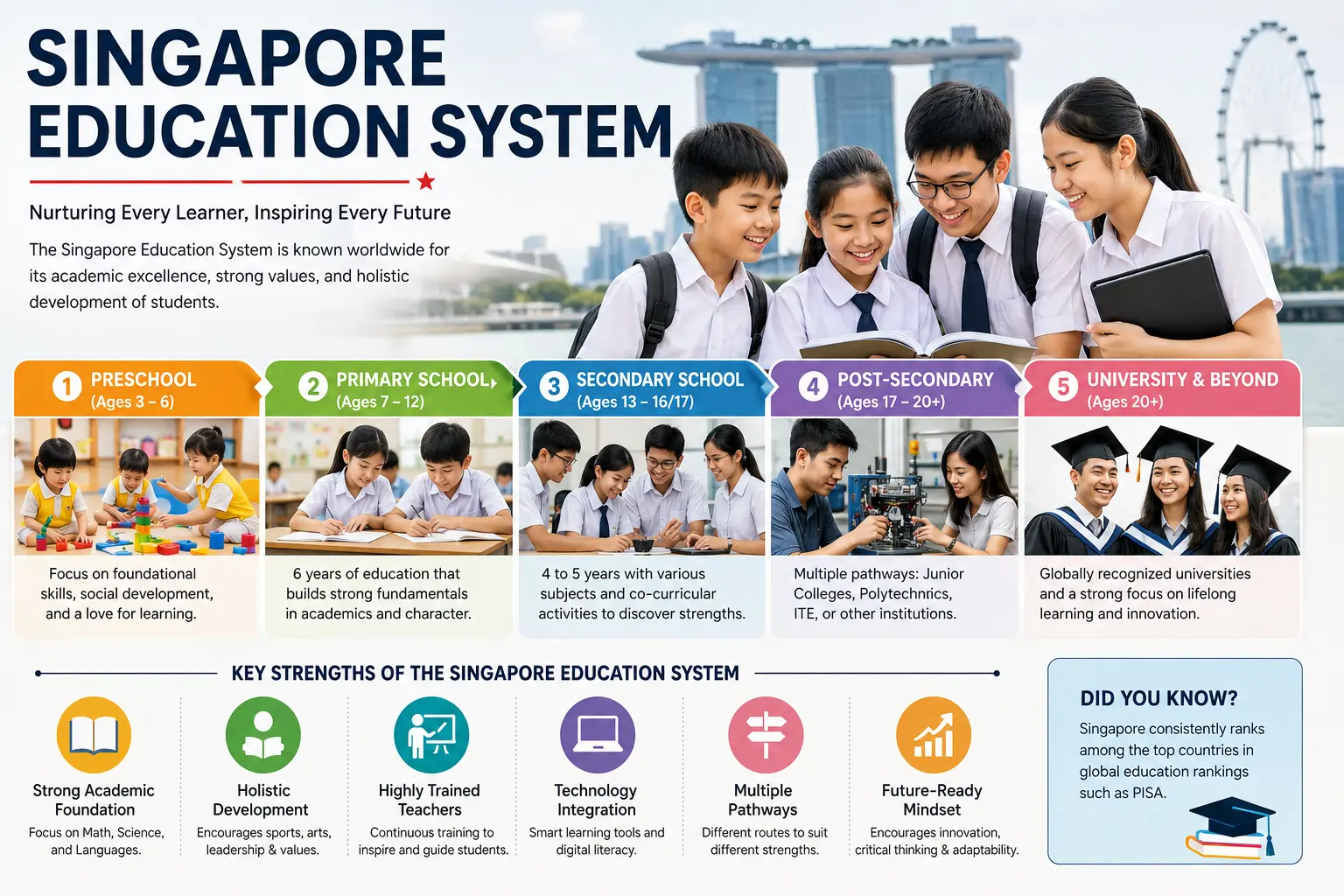

The Singapore Education System is often mentioned as one of the strongest education models in the world. Parents from different countries look at Singapore because students consistently perform well in international assessments, schools focus on both academic learning and character development, and there are many pathways for different talents.
But here’s the interesting part…
The Singapore Education System isn’t only about getting high grades. It also encourages creativity, teamwork, leadership, communication, and lifelong learning. Students are guided step by step instead of being pushed into a single path.
If you’re planning to move to Singapore, study there, or simply want to understand how the education system works, this guide covers everything in simple English.
1. Education Starts Early
Children usually begin their learning journey with preschool before entering primary school at around seven years old.
Preschool helps children build language skills, confidence, social interaction, and basic math understanding. Many parents also choose enrichment classes, although they’re not compulsory.
Once children enter primary school, learning becomes more structured. Reading, writing, mathematics, science, and languages become part of everyday classroom life.
This early foundation is one of the reasons the Singapore Education System produces confident learners.
2. Primary School Builds Strong Fundamentals
Primary education lasts for six years.
The first few years focus on building strong basics rather than rushing students into advanced topics. Teachers spend time making sure every child understands key concepts before moving forward.
Students generally study:
- English Language
- Mother Tongue Language
- Mathematics
- Science
- Social Studies
- Art
- Music
- Physical Education
Character education is also part of school life. Students learn respect, responsibility, teamwork, and good citizenship alongside academic subjects.
And yes… schools place importance on discipline without creating an unhealthy learning environment.
3. The PSLE Plays an Important Role
At the end of Primary 6, students take the Primary School Leaving Examination (PSLE).
The PSLE helps determine which secondary school pathway is the best fit for each student.
Some parents become nervous about this exam, but the purpose isn’t simply ranking students. The goal is to match students with learning environments where they can succeed.
The Singapore Education System has gradually shifted toward reducing unnecessary competition while still maintaining high academic standards.
4. Secondary School Offers Different Learning Pathways
Secondary school usually lasts four to five years.
Students don’t all follow exactly the same route. Instead, schools provide different academic pathways depending on each student’s strengths and interests.
Subjects become more specialized, including:
- Mathematics
- English
- Sciences
- Humanities
- Computing
- Design & Technology
- Literature
- Geography
- History
- Principles of Accounts
Students are also encouraged to join sports, music groups, clubs, leadership programs, and community activities.
These experiences help build confidence outside the classroom.
5. Learning Goes Beyond Books
One thing many people like about the Singapore Education System is that education doesn’t stop with textbooks.
Schools organize:
- Community service
- Leadership camps
- Outdoor education
- School performances
- Competitions
- Science fairs
- Innovation projects
These activities help students become more independent and develop practical life skills.
But they also make school much more enjoyable.
6. Multiple Routes After Secondary School
Not every student follows the same academic journey.
After secondary education, students can continue through different institutions based on their goals.
Some choose junior colleges to prepare for university.
Others attend polytechnics where they gain practical knowledge in engineering, business, design, information technology, healthcare, hospitality, and many other industries.
There are also specialized institutions and technical education options for students who prefer hands-on learning.
This flexibility is one of the biggest strengths of the Singapore Education System because success isn’t measured by a single path.
7. Universities Have Global Recognition
Singapore is home to several internationally respected universities that attract students from around the world.
Universities focus on research, innovation, entrepreneurship, technology, medicine, business, engineering, law, and many other disciplines.
Students also benefit from partnerships with international universities and multinational companies.
Many graduates find excellent career opportunities both within Singapore and overseas.
The higher education sector continues to strengthen the reputation of the Singapore Education System worldwide.
8. Technology Is Part of Everyday Learning
Digital learning has become a normal part of classroom education.
Students use online platforms, educational software, interactive presentations, and digital assignments throughout the school year.
Technology helps teachers personalize lessons while giving students access to additional learning resources.
At the same time, schools also teach digital responsibility, online safety, and critical thinking.
That’s becoming increasingly important in today’s connected world.
9. Teachers Receive Strong Professional Training
Behind every successful education system are well-trained teachers.
Teachers in Singapore regularly attend professional development programs to improve teaching methods and stay updated with new educational practices.
They don’t simply deliver lessons.
They mentor students, support emotional development, encourage teamwork, and help children become confident learners.
This continuous investment in teaching quality is one reason why the Singapore Education System maintains consistently high standards.
10. Lifelong Learning Never Really Stops
Education in Singapore doesn’t end after graduation.
Adults are encouraged to continue learning through professional certifications, workplace training, online courses, and skills development programs.
As industries change, continuous learning helps workers remain competitive.
This mindset creates a culture where learning becomes part of everyday life rather than something that only happens in school.
And honestly… that’s probably one of the biggest reasons the Singapore Education System continues to succeed.
Why the Singapore Education System Is Respected Worldwide
There isn’t one secret behind its success.
Instead, several factors work together:
- High teaching standards
- Strong curriculum
- Focus on mathematics and science
- Character development
- Technology integration
- Flexible learning pathways
- Continuous teacher training
- Government support
- Lifelong learning culture
- Safe and well-organized schools
Each piece supports the others, creating a balanced education model that prepares students for modern careers and changing industries.
Challenges Facing the Singapore Education System
Like every education system, Singapore also faces challenges.
Students sometimes experience academic pressure, especially during important examinations.
Schools continue introducing initiatives that promote mental well-being, reduce unnecessary stress, and encourage more balanced development.
The goal is not only producing academically strong students but also raising confident, creative, and emotionally healthy individuals.
That balance continues to shape the future of the Singapore Education System.
Final Thoughts
The Singapore Education System has earned global recognition because it combines academic excellence with practical learning, character building, technology, and flexible education pathways. Students receive strong foundations during primary school, explore their interests during secondary education, and have multiple opportunities to continue learning after graduation.
Perhaps the biggest lesson isn’t about exams at all.
It’s about creating learners who remain curious throughout life. As education continues evolving, the Singapore Education System shows how quality teaching, continuous improvement, and student-focused learning can work together to prepare future generations for a rapidly changing world.
Why is the Singapore Education System considered one of the best?
The Singapore Education System is respected because of its strong curriculum, highly trained teachers, excellent student performance, and balanced focus on academic achievement, character development, and lifelong learning.
At what age do children start school in Singapore?
Most children attend preschool before starting Primary 1 at around seven years old.
What is the PSLE?
The Primary School Leaving Examination (PSLE) is an assessment taken at the end of primary school to help determine suitable secondary school pathways.
Does the Singapore Education System only focus on academics?
No. Schools also encourage leadership, sports, arts, community service, teamwork, creativity, communication skills, and personal development.
Can international students study in Singapore?
Yes. Many international students attend Singapore’s public and private schools, colleges, and universities because of the country’s strong reputation for quality education.