
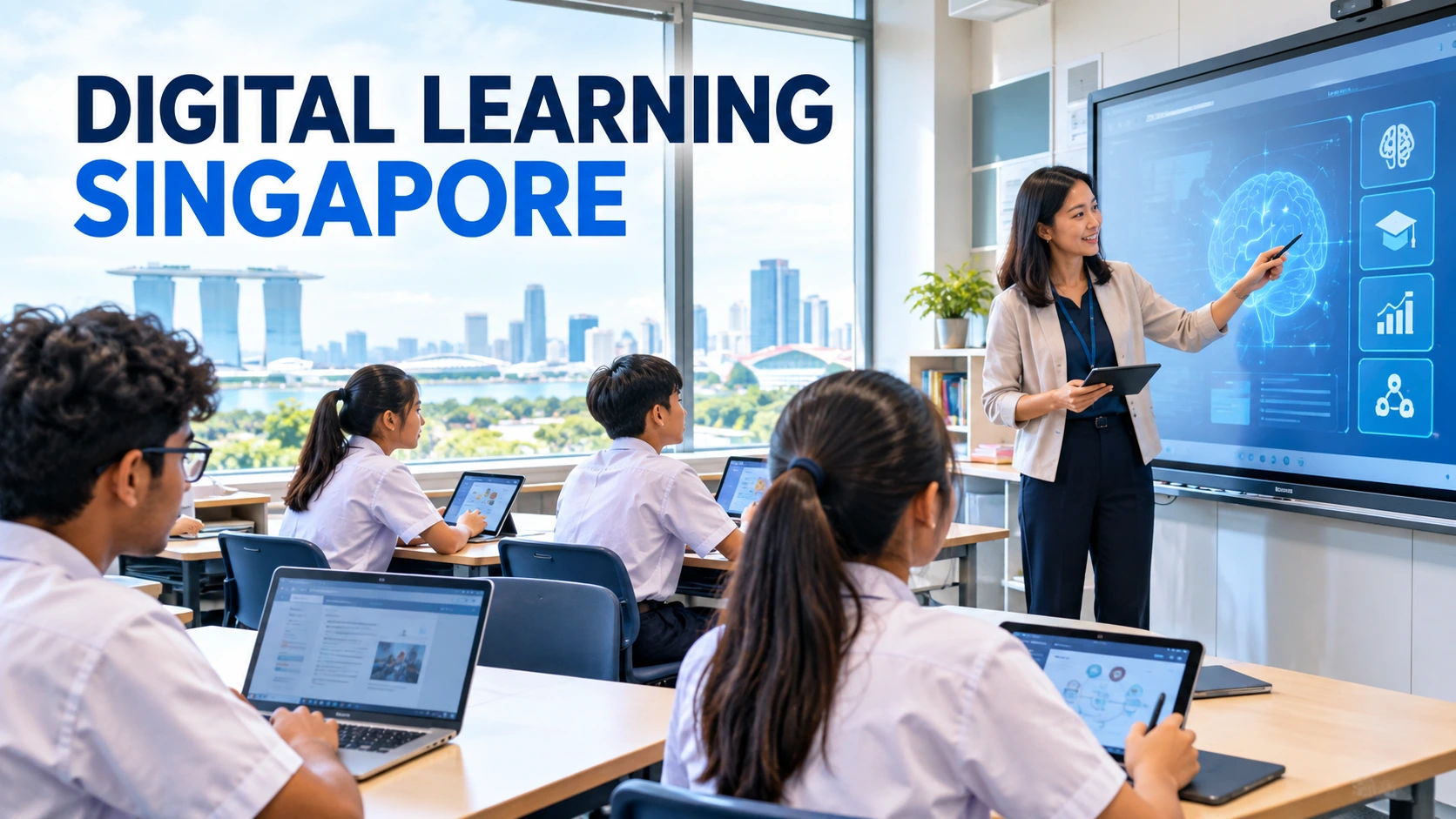

Digital learning in Singapore combines digital platforms, educational technology and online resources with classroom and independent learning. Rather than simply moving lessons online, the Singapore education system uses technology to support personalised, collaborative and self-directed learning. From the Ministry of Education’s (MOE) Singapore Student Learning Space (SLS) to Personal Learning Devices (PLDs), digital tools now play an important role in teaching and learning. Digital Learning Singapore also extends beyond schools, with universities, adult learners and working professionals using online learning for lifelong learning and skills development. AI-enabled tools are adding another layer, supporting feedback, adaptive learning and teacher practice.
TL;DR: Digital Learning Singapore at a Glance
Digital Learning Singapore combines classroom teaching with SLS, Personal Learning Devices (PLDs), digital resources and blended learning. MOE’s approach focuses on digital literacy, personalised and self-directed learning rather than simply replacing teachers with technology. SLS is a core school platform, while online courses support adult learning and professional upskilling. AI-enabled learning is also expanding, with MOE emphasising safe and responsible use.
| Area | What to Know |
| Main school platform | Singapore Student Learning Space (SLS) |
| Key initiative | National Digital Literacy Programme (NDLP) |
| Student devices | Personal Learning Devices (PLDs) |
| Learning approach | Blended, personalised and self-directed learning |
| Skills | Digital literacy, collaboration and responsible technology use |
| Beyond schools | Higher education, adult learning and professional upskilling |
What Is Digital Learning in Singapore?
Digital learning in Singapore refers to the purposeful use of technology, digital resources and online platforms to enhance teaching and learning. It can take place inside a classroom, at home or through an entirely online course. It includes educational technology, interactive resources, online assessments, collaborative activities and tools that help learners study independently.
That makes digital learning broader than online learning Singapore or conventional e-learning. A student using digital resources during a face-to-face lesson is already participating in technology-enabled learning.
Blended learning combines classroom interaction with digital activities, while self-directed learning gives learners greater ownership over what, when or how they study.
| Learning Type | How It Works | Common Use |
| Digital learning | Technology supports teaching and learning | Schools, universities, workplaces |
| Online learning | Learning takes place mainly online | Courses and professional training |
| Blended learning | Face-to-face and digital activities | Schools and higher education |
| Self-directed learning | Learner takes greater ownership | SLS, independent study, upskilling |
How Does Digital Learning Work in Singapore Schools?
Singapore’s approach connects technology with broader educational goals rather than treating devices as an end in themselves. The ecosystem includes the National Digital Literacy Programme (NDLP), Personalised Digital Learning Programme (PDLP), Personal Learning Devices and SLS.
Together, these initiatives can be understood as a connected framework: MOE sets the broader direction, digital-literacy initiatives develop students’ competencies, PLDs provide access to digital tools, and SLS supports day-to-day teaching and learning.
The emphasis is on building digital literacy and technological skills while creating opportunities for personalised, collaborative and self-directed learning. SLS V2, for example, supports MOE’s EdTech Masterplan 2030 through digital-literacy resources, AI-enabled tools and greater customisation of learning.
Technology does not remove the teacher from this process. Teachers still guide learning, choose appropriate resources, monitor progress and determine when technology adds value.
| Programme / Tool | Purpose | Mainly For |
| NDLP | Develop digital literacy and competencies | Students |
| PDLP | Support technology-enabled personalised learning | Secondary students |
| PLDs | Provide access to digital learning tools | Students |
| SLS | Provide curriculum-aligned digital resources and tools | Teachers and students |
What Is the Singapore Student Learning Space (SLS)?
The Singapore Student Learning Space (SLS) is MOE’s core platform for teaching and learning. It provides curriculum-aligned resources and tools designed to support different and evolving learning needs.
For students, SLS acts as a central environment for accessing learning resources, completing activities and engaging in self-directed and collaborative learning. Its self-study features also allow learners to organise resources, make notes, track progress and use tools such as the Adaptive Learning System.
Teachers can use SLS to design learning activities, provide feedback, monitor student understanding and customise lessons. This is why it is better understood as a teaching-and-learning ecosystem than simply an online portal.
SLS is also evolving alongside Singapore’s wider EdTech strategy, with newer features supporting personalised learning, AI-assisted feedback and data-informed teaching.
How Much Does Digital Learning Cost in Singapore?
There is no single digital learning cost in Singapore. The amount depends on whether someone is accessing school-supported resources, taking a commercial online course, completing professional training or enrolling in a higher-education programme.
For school students, access to SLS operates within the school system, while separate costs or support arrangements may apply to devices and related programmes. Adult learners face much greater variation because online course fees in Singapore depend on the provider, course length, subject and whether certification is included.
For this reason, learners should check the current fee and available funding or subsidy directly with the institution before enrolling.
| Digital Learning Option | Typical Cost Structure | Main Cost Factors |
| School digital learning | School/programme dependent | Device and support arrangements |
| SLS | School-system access | MOE/school provision |
| Online short courses | Free or paid | Provider, duration and content |
| Professional training | Course dependent | Certification and course length |
| Higher education | Institution dependent | Qualification and programme |
| Corporate e-learning | Usually custom-priced | Users, platform and content |
How Is AI Changing Digital Learning in Singapore?
AI is becoming a more visible part of Digital Learning Singapore, but the emphasis is on using it to support rather than replace teaching.
SLS now includes several AI-enabled features. Its Adaptive Learning System can provide personalised learning pathways and immediate feedback, while the Authoring Copilot helps teachers with lesson planning. Other features support feedback, analysis of student responses and guided student learning.
MOE states that AI-enabled SLS features are designed to personalise learning, provide timely feedback and support teachers’ professional practice. They are also subject to governance and safety considerations.
Responsible use matters. MOE’s AI in Education Framework is built around Agency, Inclusivity, Fairness and Safety, reinforcing the importance of AI literacy alongside technical capability.
Digital Learning for Adults and Working Professionals
Digital learning in Singapore extends well beyond primary and secondary education. Adult learners and working professionals can use online courses, blended programmes and technology-enhanced training for professional development, workforce upskilling and reskilling.
This is particularly relevant as digital and AI skills become more closely connected with changing workplace requirements.
Singapore’s Institute for Adult Learning has developed the AE Digital and AI Proficiency Taxonomy (ADAPT) for adult educators. The framework covers areas including technology-enhanced learning, digital and AI literacy, assessment, professional development and responsible technology use.
For learners, this wider lifelong-learning environment means digital education can continue throughout a career rather than ending with formal schooling.
Benefits and Challenges of Digital Learning
Digital learning can improve access to resources and make learning more flexible, interactive and responsive to individual needs. However, effective implementation also requires attention to digital well-being, privacy, accessibility and responsible technology use.
| Benefits | Challenges |
| Flexible access to learning | Screen time |
| Personalised learning | Digital distractions |
| Self-directed learning | Unequal access |
| Interactive resources | Cyber safety |
| Collaborative learning | Privacy considerations |
| Digital competencies | Over-reliance on technology |
The key is the purposeful use of technology. A new device or AI tool does not automatically improve learning outcomes. Good teaching, appropriate resources and student support remain essential.
Cyber wellness and digital well-being are equally important. Learners need to know how to evaluate information, protect personal data, manage technology responsibly and recognise the limitations of digital and AI-generated content.
What Is the Future of Digital Learning in Singapore?
The future of digital learning in Singapore is increasingly connected with personalised learning, AI-enabled educational tools, digital literacy and stronger technological competencies.
MOE’s EdTech Masterplan 2030 places emphasis on using technology more effectively for teaching and learning while equipping students with digital literacy and technological skills for the future.
SLS already demonstrates this direction through adaptive learning, AI-assisted feedback and tools that support teachers. The likely focus is therefore not technology replacing educators, but educators and learners using increasingly capable tools responsibly. Adult education will also remain important as workers continuously update their digital and AI skills.
FAQs About Digital Learning Singapore
What is digital learning in Singapore?
Digital learning in Singapore is the use of digital platforms, devices, educational technology and online resources to support teaching and learning. It includes classroom technology, blended learning, online education, personalised learning and self-directed study.
What is SLS in Singapore?
The Singapore Student Learning Space (SLS) is MOE’s core platform for teaching and learning. It provides curriculum-aligned resources and tools that support students and teachers, including opportunities for collaborative and self-directed learning.
Is digital learning free in Singapore?
Some digital learning resources are provided through Singapore’s school system, while commercial online courses, professional training and higher-education programmes may charge fees. Costs therefore depend on the learner, provider, programme and type of training.
What are the benefits of digital learning for students?
Digital learning can provide flexible access to resources, personalised learning opportunities, interactive activities and greater scope for self-directed learning. It can also help students develop digital literacy and technological skills relevant to further study and future workplaces.
How is AI used in Singapore education?
AI-enabled SLS tools can support personalised learning, immediate feedback, lesson planning and analysis of student responses. MOE also emphasises safe, responsible use through its AI governance and AI in Education frameworks.
Conclusion
Digital Learning Singapore is developing around purposeful technology use rather than technology for its own sake. MOE initiatives, SLS, digital literacy, blended learning and AI-enabled tools are helping students learn in more personalised and self-directed ways, while digital learning also supports lifelong learning for adults. As the tools become more capable, effective teaching, critical thinking and responsible digital participation remain central to making them useful. Pasted markdown
[…] few simple habits can make MOE Learning Resources much easier to […]