

Every parent wants their child to have the best learning journey after the PSLE. But once the exams are over, another important topic starts coming up—PSLE Subject Combination.
Many parents think subject combinations are only about choosing easy or difficult subjects. That’s not really how it works. The right combination should match a student’s strengths, interests, and future learning needs.
And honestly… there isn’t one “perfect” combination for everyone.
This guide explains everything you need to know about PSLE Subject Combination in Singapore, how schools decide subject levels, what options students usually receive, and how families can make informed decisions without unnecessary stress.
What Is a PSLE Subject Combination?
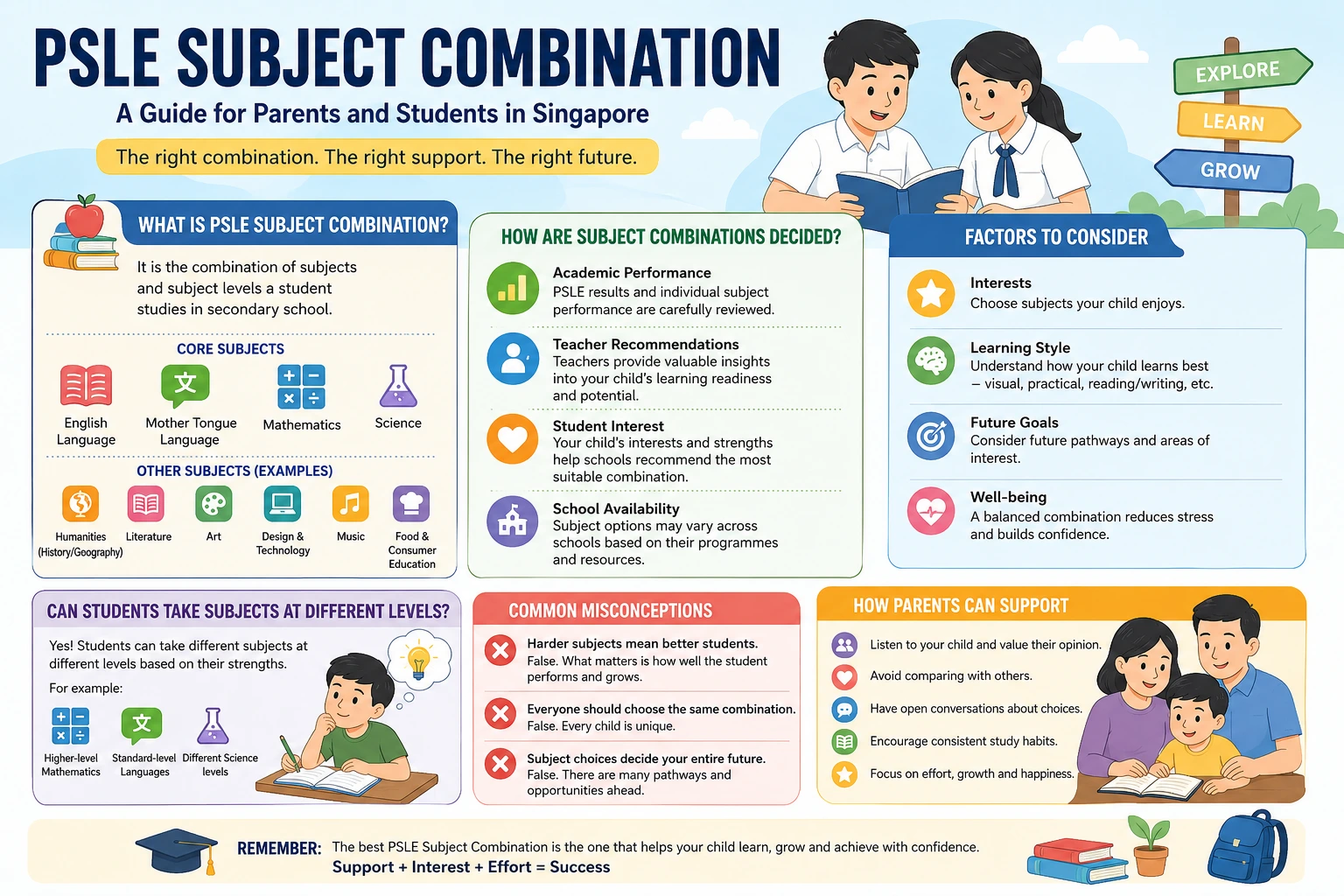
A PSLE Subject Combination refers to the mix of subjects and subject levels a student studies after entering secondary school.
Students continue learning core academic subjects such as:
- English Language
- Mathematics
- Science
- Mother Tongue Language
They also study additional subjects like:
- History
- Geography
- Literature
- Design & Technology
- Food and Consumer Education
- Art
- Music
- Computer-related subjects in selected schools
Under Singapore’s education system, students may study different subjects at different levels depending on their strengths rather than taking every subject at exactly the same level.
This gives students more flexibility and allows them to learn at a pace that suits them.
Why Is the Right PSLE Subject Combination Important?
Choosing the right PSLE Subject Combination affects much more than just school grades.
It can influence:
- Learning confidence
- Interest in school
- Academic progress
- Subject strengths
- Future educational pathways
A student who enjoys Science may perform much better when given opportunities to study advanced Science subjects.
Someone stronger in languages may shine with subjects involving writing, reading, and communication.
That’s why schools don’t encourage parents to chase “harder” subjects just because they sound more impressive.
The best combination is usually the one where the student can consistently perform well while enjoying the learning process.
How Are PSLE Subject Combinations Decided?
Schools look at several factors before recommending a PSLE Subject Combination.
These commonly include:
Academic Performance
PSLE Achievement Levels (AL) provide an overall picture of a student’s strengths.
Schools also review individual subject performance rather than only the total score.
Teacher Recommendations
Primary school teachers understand a student’s learning habits, classroom participation, and readiness for more challenging work.
Their recommendations often help secondary schools make suitable decisions.
Student Interest
Many schools also ask students about subjects they enjoy.
A child interested in coding, design, science, or languages may receive recommendations that better match those interests.
School Subject Availability
Not every secondary school offers exactly the same electives.
Some schools specialise in STEM.
Others offer more arts or language programmes.
The available PSLE Subject Combination may vary slightly between schools.
Common Secondary School Subject Combination Structure
Although schools differ, most students study a balanced group of subjects.
A typical subject combination includes:
- English Language
- Mother Tongue Language
- Mathematics
- Science
- History or Geography
- Literature (selected schools)
- Design & Technology or Food and Consumer Education
- Art
- Music
- Physical Education
As students move into upper secondary levels, they usually have more opportunities to choose elective subjects based on their interests.
Can Students Study Different Subjects at Different Levels?
Yes.
This is one of the biggest advantages of Singapore’s education system today.
Instead of studying every subject at the same level, students can take individual subjects at a level that matches their ability.
For example:
- Higher-level Mathematics
- Standard-level Languages
- Different Science levels depending on performance
This flexibility helps students stay challenged where they excel while receiving appropriate support in subjects they find more difficult.
It creates a more personalised learning experience.
Factors Parents Should Consider Before Choosing a PSLE Subject Combination
Parents often focus only on examination results.
But there’s more to think about.
Your Child’s Interests
A child interested in Science usually enjoys experiments, problem-solving, and discovery.
Someone who enjoys reading may naturally perform better in language-related subjects.
Interest often leads to better motivation.
Learning Style
Some children learn best through practical activities.
Others enjoy reading textbooks and writing essays.
Understanding your child’s learning style makes choosing subjects much easier.
Future Goals
While students don’t need to decide on a career immediately, having general interests can help.
Someone interested in engineering may enjoy stronger Mathematics and Science.
Someone interested in media or communications may benefit from language-rich subjects.
Stress Level
Taking the most demanding combination isn’t always the smartest decision.
A balanced workload often produces better long-term results.
Happy students usually become successful learners.
Common Misconceptions About PSLE Subject Combination
Let’s clear up a few myths.
“Harder Subjects Mean Better Students”
Not true.
Success depends on how well the student performs, not how difficult the subject appears.
“Everyone Should Choose the Same Combination”
Every child learns differently.
One combination may work perfectly for one student but not another.
“Subject Choices Decide Your Entire Future”
No.
Singapore offers many educational pathways.
Students continue discovering new interests throughout secondary school and beyond.
Subject combinations are important—but they’re not permanent life decisions.
How Parents Can Support Their Child
Parents play an important role during this transition.
Some simple ways to help include:
- Listen to your child’s interests.
- Avoid comparing them with classmates.
- Discuss school recommendations openly.
- Encourage consistent study habits.
- Focus on long-term learning instead of short-term pressure.
Children perform better when they feel supported instead of pressured.
Sometimes a simple conversation makes a bigger difference than hours of tuition.
Questions to Ask During Secondary School Orientation
Orientation sessions are a great opportunity to learn more about your child’s future studies.
Consider asking:
- How are subject combinations assigned?
- Can students change subjects later?
- What electives does the school offer?
- Are there Higher Mother Tongue options?
- What academic support is available?
- How are students reviewed each year?
These questions can help parents better understand the school’s approach.
Final Thoughts
Choosing the right PSLE Subject Combination doesn’t have to feel overwhelming.
Every child has different strengths, interests, and learning styles. The goal isn’t to find the “hardest” combination. It’s to find the one that helps your child grow, stay motivated, and build confidence throughout secondary school.
Take time to understand your child’s abilities, listen to school recommendations, and keep future opportunities in mind. With the right balance, students can enjoy learning while preparing themselves for the next stage of their education.
Remember… success isn’t determined by one subject combination. It’s built through steady effort, curiosity, and the willingness to keep learning.
What is a PSLE Subject Combination?
A PSLE Subject Combination is the group of subjects and subject levels that students study after entering secondary school in Singapore.
Who decides the PSLE Subject Combination?
Secondary schools usually determine the subject combination based on PSLE results, subject performance, teacher recommendations, student interests, and available school programmes.
Can students take different subjects at different levels?
Yes. Singapore’s education system allows students to study different subjects at levels that best match their individual strengths and learning needs.
Can students change their subject combination later?
Some schools allow adjustments after reviewing a student’s academic performance. Policies differ between schools.
Does the PSLE Subject Combination affect future education?
Yes, it can influence later subject choices and learning pathways, but students still have many opportunities to explore different educational and career options as they progress through secondary school.

