

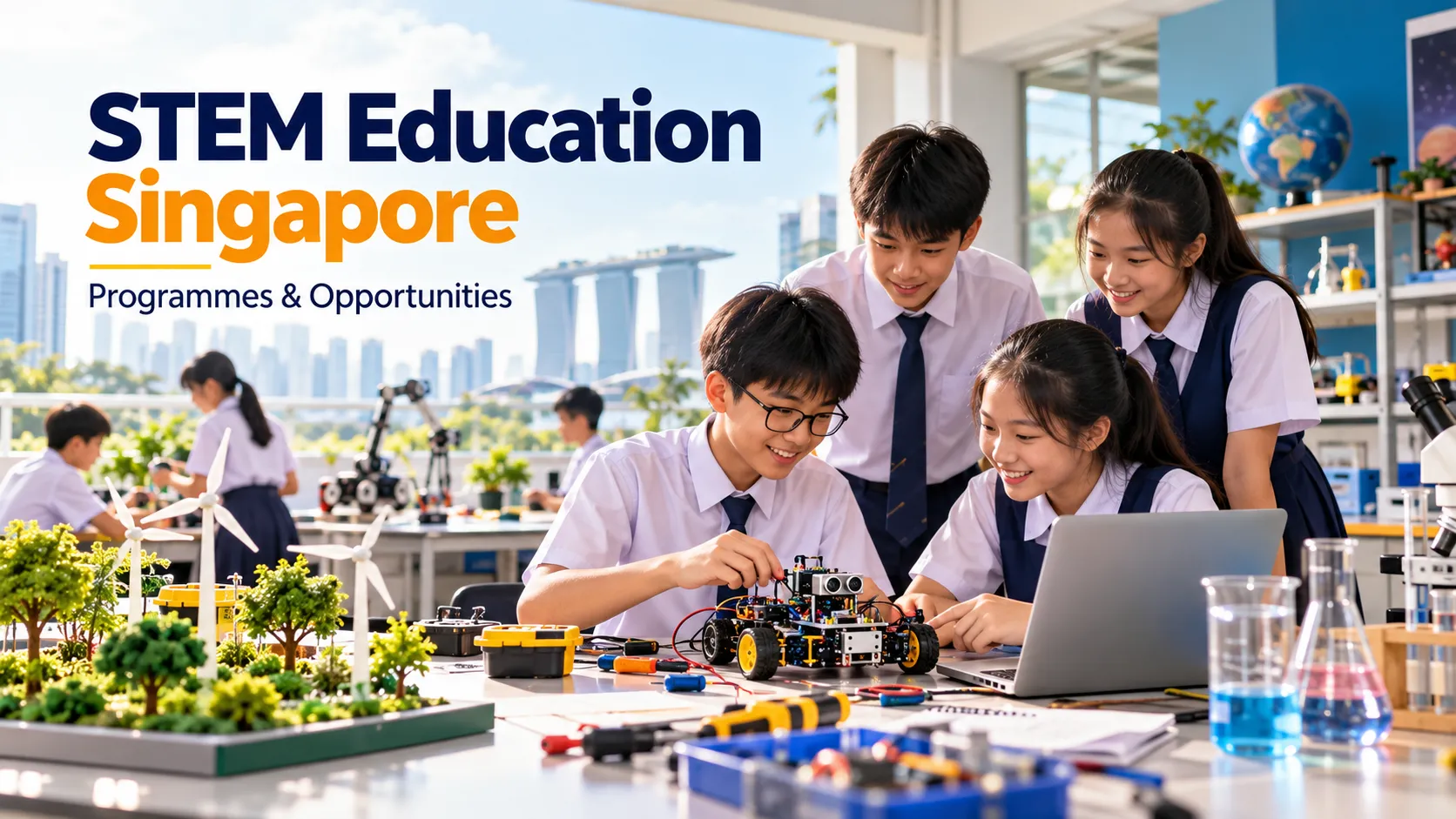
STEM Education Singapore brings Science, Technology, Engineering and Mathematics together through practical learning, problem-solving and real-world applications. Instead of treating these areas as completely separate subjects, STEM learning can ask students to investigate a problem, design something, test an idea and improve it. In Singapore schools, this approach can appear through school-based programmes, the Applied Learning Programme (ALP), science activities and hands-on projects. Parents may also come across STEM through Science Centre Singapore programmes, competitions and private enrichment programmes. The exact experience depends on the school, age group and programme. Singapore’s education system also places emphasis on applying knowledge, developing problem-solving skills and connecting learning with real-life situations.
TL;DR: STEM Education Singapore at a Glance
- STEM combines Science, Technology, Engineering and Mathematics.
- Singapore schools can use applied and experiential learning to connect classroom concepts with practical situations.
- STEM can appear through school programmes, STEM-ALP, projects, competitions and enrichment.
- Primary and secondary students may take part in different STEM activities.
- Coding, robotics, engineering and sustainability are common STEM themes, but STEM is broader than these areas.
- Parents comparing external programmes should check age suitability, learning objectives, hands-on work, programme duration and current fees.
What Is STEM Education in Singapore?
The four STEM subjects in Singapore are Science, Technology, Engineering and Mathematics. STEM education brings ideas from these areas together through inquiry, experimentation, design and problem-solving rather than simply teaching them as isolated topics. Singapore’s science curriculum, for example, places emphasis on scientific inquiry and applying scientific knowledge to issues connected with daily life, society and the environment.
What STEM Stands For
| STEM Area | What It Can Include |
| Science | Experiments, observation, scientific inquiry |
| Technology | Coding, digital tools, programming |
| Engineering | Designing, building, testing solutions |
| Mathematics | Measurement, data, modelling |
STEM learning can be interdisciplinary. A student might use mathematics to measure results, science to explain what happened, technology to collect or process information, and engineering ideas to build a workable design. That kind of practical application can also develop critical thinking, creativity and communication alongside subject knowledge.
So, STEM Singapore does not simply mean “coding class” or “robotics class”. Those can be part of it, but students may also work on environmental science, health, transportation, sustainability, materials or engineering problems.
How Does STEM Education Work in Singapore?
STEM education in Singapore can take place through school-based applied learning, curriculum-linked activities, projects, competitions and external programmes. At secondary level, the Applied Learning Programme gives schools a way to connect classroom learning with real-life issues and authentic contexts.
STEM Applied Learning Programme (STEM-ALP)
The STEM Applied Learning Programme, often referred to as STEM-ALP, is a school-based programme rather than a private STEM tuition class. Schools can use applied learning to give students hands-on experiences connected to real-world problems and interdisciplinary STEM topics.
Science Centre Singapore’s STEM Inc supports STEM Applied Learning Programmes and lists school programmes covering areas such as game design and making, health science, materials science, sustainability, transportation, emerging technologies and cities and urban landscapes.
School-Based STEM Learning
The actual STEM curriculum experience can differ between schools. For example, an MOE school may offer an ALP focused on sustainability, computing, food science, transportation or another applied topic. MOE school profiles show these programmes can have quite specific themes.
And that is useful for parents checking schools — the programme name alone does not tell you exactly what students will do. Look at the school’s current programme details.
Science Centre Singapore and STEM Inc
Science Centre Singapore plays a major role in Singapore’s STEM learning scene. STEM Inc supports schools with STEM-related programmes, while Science Centre also runs school activities, competitions and learning experiences. Its 2026 National Robotics Competition, for example, gives students opportunities to design and program robots around challenge-based tasks.
STEM Education for Primary School Students
Yes, STEM education is available for primary school students in Singapore, although the exact activities depend on the school or programme. Primary STEM learning can include science experiments, engineering challenges, coding, robotics, design projects and environmental activities.
Science Centre Singapore’s Young Scientist Badge Scheme is designed for primary students and complements formal science learning with STEM activities beyond the classroom. Its current scheme includes areas such as engineering, mathematics, IT, ecology, energy and digital fabrication.
Depending on the school or programme, students may also explore Singapore-specific themes such as sustainability, urban farming, environmental science or the challenges of living in a land-scarce city. The point is not to make a Primary 3 student sit through an engineering lecture. Good primary STEM learning is usually more hands-on — observe, ask, build, test, change something and try again.
STEM Education for Secondary School Students

STEM education secondary school Singapore programmes can involve deeper projects, engineering tasks, coding, robotics, scientific investigation, design thinking and sustainability. STEM-ALP is one route, with schools choosing themes that match their programmes and student interests.
Science Centre Singapore’s STEM Inc network lists many secondary schools offering STEM Applied Learning Programmes, with themes covering areas such as future transportation, sustainability and emerging technologies.
Students can also take part in STEM competitions and engineering opportunities. The Young Engineering Award, run by Science Centre Singapore with Singapore Polytechnic, gives secondary students a platform to explore the connection between science and engineering and recognise students with a strong interest in engineering.
Some students may also explore talent-development routes such as DSA, but STEM-related offerings and selection criteria vary by school. Parents should check the school’s current DSA information rather than assuming that a STEM programme automatically creates a DSA pathway.
STEM Programmes and Opportunities in Singapore
Parents searching for STEM programmes Singapore may see school-based options, Science Centre activities, private enrichment classes and competitions. They are not all designed for the same purpose.
| STEM Opportunity | Typical Audience | Main Focus |
| School STEM/ALP | Primary & Secondary | Applied learning |
| Science Centre STEM programmes | Students/Schools | Hands-on STEM |
| Engineering programmes | Secondary students | Engineering exposure |
| STEM enrichment | Children/Students | Extended learning |
| STEM competitions | Interested students | Innovation and problem-solving |
School-based STEM is connected to the school’s curriculum and programme structure. Private STEM enrichment is usually an extra activity outside the core school timetable. A robotics class might focus heavily on building and programming, while a broader STEM programme could include science experiments, engineering design, sustainability and data work.
Science Centre Singapore also maintains a STEM Calendar for schools, which brings together STEM activities that schools can search by level, subject, activity type and organisation.
STEM Programme Fees in Singapore
There is no single standard STEM education fee in Singapore. Costs can differ based on provider, programme type, duration, materials, class size and age group. Current provider information should be checked before comparing prices.
| STEM Learning Option | Fee Structure | What Can Affect Cost |
| School-based STEM/ALP | School-specific | Programme structure |
| Science Centre programmes | Programme-specific | Activity and duration |
| Private STEM enrichment | Provider-specific | Sessions and class size |
| Holiday STEM camps | Provider-specific | Camp length and activities |
Some Science Centre offerings publish programme-specific details rather than one general STEM fee. Its 2026 booking system, for example, lists activities by education level, duration and delivery format.
So if you are comparing STEM programme fees Singapore, check what the quoted price actually covers — materials, number of sessions, project work, class size and any registration or admission charges.
What Skills Does STEM Education Develop?
Students can develop problem-solving, critical thinking, creativity, collaboration, communication and inquiry skills through STEM education. Practical STEM work can also build computational thinking, design thinking, digital literacy and basic data-analysis skills.
Common skills include:
- Problem-solving: breaking a practical challenge into manageable parts.
- Critical thinking: examining evidence and deciding what to test next.
- Creativity: generating and improving possible solutions.
- Collaboration: working with classmates on projects and tasks.
- Communication: explaining ideas, results and design choices.
- Computational thinking: organising problems into logical steps.
- Data analysis: collecting, comparing and interpreting information.
The exact skills developed depend on the activity. Building a robot, investigating plant growth and designing a sustainable product do not create the same learning experience.
How Parents Can Choose a STEM Programme in Singapore
A good STEM enrichment programme should match the child’s age, interests and actual learning needs. The programme description matters more than a flashy title.
Check Before Enrolling
- Age suitability: Is the content appropriate for the student’s level?
- Learning objectives: What should students know or be able to do after the programme?
- Hands-on project work: Will students build, test, investigate or create something?
- Teacher experience: What STEM background or teaching experience do instructors have?
- Class size: How many students work with each teacher?
- Programme duration: Is it a one-off workshop or a longer course?
- School-based or private: Is it connected to the school curriculum or external enrichment?
- Coding/robotics vs broader STEM: Does the content match what the child actually enjoys?
- Fees and materials: Are equipment, kits or other materials included?
- Location and schedule: Can the student attend consistently without creating unnecessary travel time?
And ask for a sample session or project description if one is available. It can tell you much more than a programme name.
STEM Education Singapore FAQs
What is STEM education in Singapore?
STEM education in Singapore combines Science, Technology, Engineering and Mathematics through inquiry, practical application, design and problem-solving. Students may encounter STEM through school programmes, ALP, competitions, Science Centre activities or private enrichment.
What is STEM ALP in Singapore?
STEM ALP refers to the STEM Applied Learning Programme. It is a school-based applied learning approach that connects classroom knowledge with real-life issues, practical projects and STEM-related themes. The exact focus differs between schools.
Is STEM education available in Singapore primary schools?
Yes. Primary students can take part in STEM-related learning through school activities and programmes. Science is formally introduced as a subject from Primary 3, while Science Centre programmes and STEM initiatives can provide extra opportunities beyond normal classroom learning.
What are the four STEM subjects?
The four STEM areas are Science, Technology, Engineering and Mathematics. STEM learning can connect these areas through experiments, coding, data, engineering design, measurement and practical problem-solving.
What are common STEM activities in Singapore?
Common activities include coding, robotics, science experiments, engineering design, sustainability projects, environmental investigations, data activities and technology-based projects. Science Centre Singapore’s current school offerings include robotics and programmes linked to science, sustainability, engineering and technology.
How much do STEM programmes cost in Singapore?
STEM programme costs vary by provider and format. School-based STEM and ALP programmes have their own arrangements, while external enrichment, workshops and camps can have separate fees. Check the current provider information before enrolling.
Final Thoughts
STEM Education Singapore covers much more than coding and robotics. It can involve science inquiry, engineering design, mathematics, technology, sustainability and hands-on projects that connect classroom learning with practical situations. School-based ALP is an important part of this approach, while Science Centre programmes, competitions and enrichment give students other ways to explore STEM. Primary and secondary opportunities are not identical, so parents should look at the actual programme content, age suitability, duration and current cost before choosing an option.

