

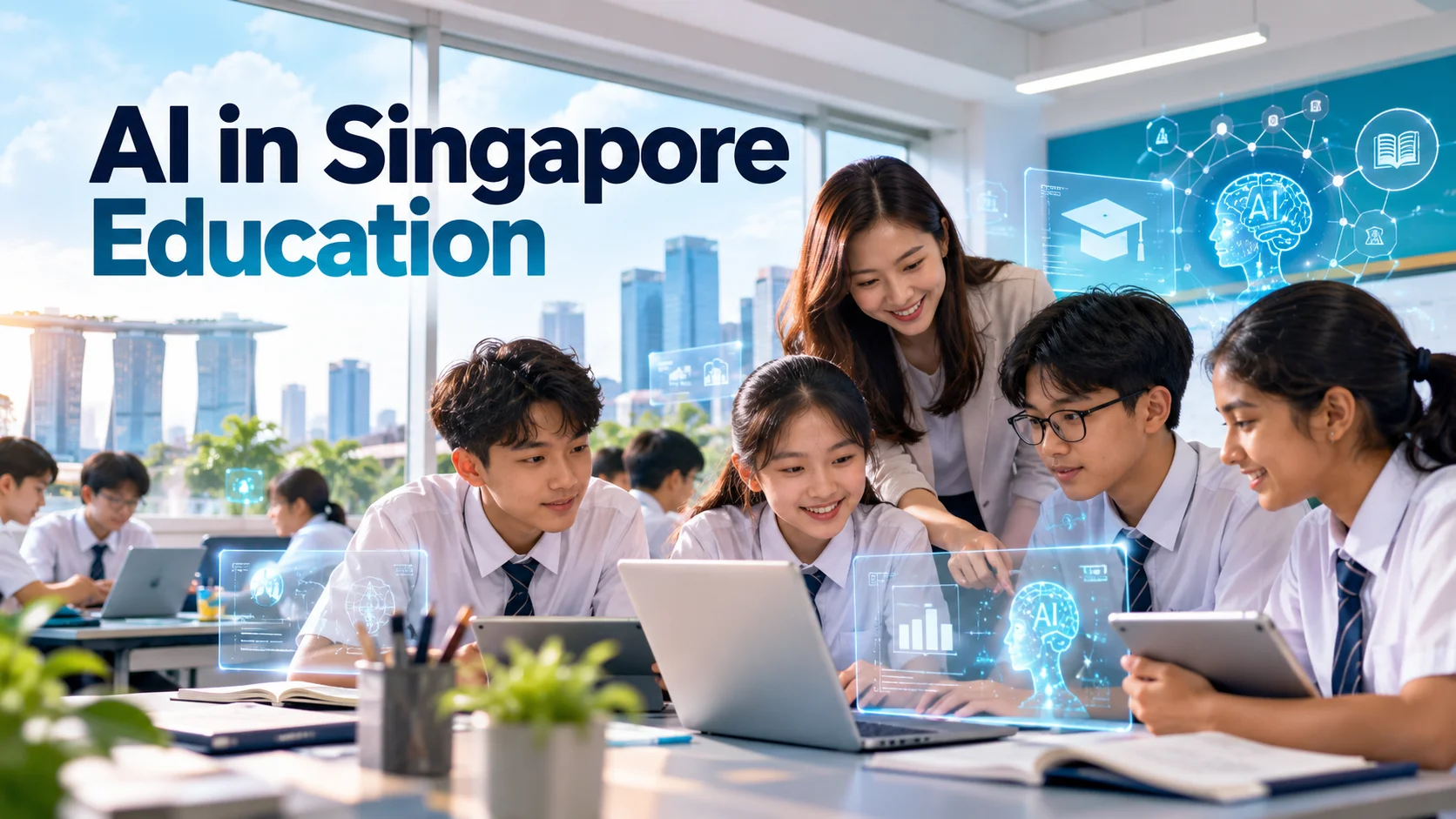
Artificial intelligence is no longer something Singapore students only hear about in technology news. It is becoming part of how young people learn, research, solve problems and prepare for future careers.
AI in Singapore Education is also moving beyond simply giving students access to new software. The bigger goal is teaching them how to work with AI without becoming dependent on it.
In 2026, Singapore’s Ministry of Education (MOE) is strengthening AI literacy across the education journey. Students are being taught not only how AI can help them, but also how to question its answers, identify false information and use it responsibly.
That shift could change what everyday learning looks like in Singapore schools.
What Is AI in Singapore Education?
AI in education means using artificial intelligence to support teaching and learning.
A student might use an AI-supported learning system to practise mathematics. A teacher could use technology to identify areas where a class needs more help.
AI can also support language learning, research, coding, revision and digital skills.
But Singapore’s approach is not simply about putting an AI chatbot in front of every student.
The focus is increasingly on AI literacy — understanding what AI does, how to use it and when its output should not be trusted.
Why Singapore Is Focusing on AI Now
The workplace Singapore students will enter is changing quickly.
AI is already being used across areas such as banking, engineering, healthcare, logistics, cybersecurity, media and business.
Schools therefore face a new challenge.
Students need strong academic foundations, but they also need the confidence to work with technology that may look very different by the time they start their careers.
Singapore has been developing this foundation through its National Digital Literacy Programme and EdTech plans. MOE’s EdTech Masterplan 2030 includes strengthening students’ digital literacy and technological skills as one of its strategic directions.
AI now adds another layer to that preparation.
What Changed for AI Education in 2026?
One of the biggest developments came through MOE’s 2026 education announcements.
MOE said AI literacy is being integrated into curriculum, co-curriculum activities and self-directed learning resources. Students will develop these abilities through defined milestones during their education journey.
The existing Code for Fun programme is also being updated.

The refreshed programme will place greater emphasis on AI skills and is planned to become available to all primary and secondary schools in 2027.
This makes AI education much broader than a specialist computing subject.
A student does not necessarily need to plan a career in computer science to benefit from understanding artificial intelligence.
What Could an AI-Supported Classroom Look Like?
Imagine two students working on the same mathematics topic.
One understands the first few questions immediately. The other keeps making the same mistake.
A digital learning system can recognise these different learning patterns and provide different levels of support.
The first student could move to harder questions, while the second receives additional practice.
That does not remove the teacher.
Instead, it can give the teacher another way to see where students may need attention.
AI Can Make Practice More Personal
Students do not all learn at exactly the same speed.
Some need several examples before a concept becomes clear. Others are ready to move ahead quickly.
AI-supported learning can help make practice more responsive to these differences.
For example, a student struggling with grammar could receive additional exercises around the mistakes they commonly make.
Someone preparing for a science topic could receive questions focused on areas they have not yet mastered.
The benefit is not simply getting more questions.
It is getting practice that better matches the learner’s current needs.
How AI May Help Singapore Teachers
Teachers spend a significant amount of time outside actual classroom teaching.
Lessons need to be prepared. Student work needs feedback. Resources need to be organised and learning progress needs to be understood.
AI can potentially assist with parts of this workload.
A teacher might use it to generate an initial set of practice questions, explore different examples for a lesson or organise ideas for learning activities.
The teacher still checks the result before students see it.
That distinction matters.
MOE has previously described AI as something that can help educators handle routine work while allowing them to focus on more complex responsibilities and relationships with students.
Where AI Fits Across Singapore Education
AI will not look exactly the same at every stage.
| Education Stage | Possible Role of AI | Main Learning Focus |
|---|---|---|
| Primary School | Guided activities and basic AI exposure | Safe and responsible use |
| Secondary School | Research, coding and AI-supported learning | AI literacy and critical thinking |
| Junior College | Research and deeper subject applications | Evaluation and independent thinking |
| Polytechnic | Practical industry applications | Job-ready AI skills |
| ITE | Applied technology training | Workplace use of AI |
| University | Advanced AI study and research | Specialisation and innovation |
| Adult Learning | AI courses and reskilling | Career adaptation |
The level of independence can increase as learners become older.
A primary school student may need close guidance, while a university student might use AI as part of advanced research or technical work.
AI Is Changing the Meaning of Homework
Homework used to have a simple assumption behind it: the student produced the answer.
Generative AI makes that assumption harder.
A student can now ask an AI system to write an essay, solve a problem or summarise a chapter within seconds.
The question for schools is therefore changing from:
“Did the student submit the assignment?”
to:
“Did the student actually understand the work?”
This may encourage teachers to place greater value on reasoning, classroom discussion, drafts and explanations of how students reached their answers.
Students Need to Learn That AI Can Be Wrong
One of the most important lessons about AI is surprisingly simple:
It can make mistakes.
An AI-generated response can sound confident even when the information is inaccurate.
Young students may find this especially difficult because polished writing can appear trustworthy.
That is why checking sources is becoming an important digital skill.
Students need to learn to ask where information came from, whether another reliable source confirms it and whether the answer actually makes sense.
Deepfakes Are Now an Education Issue
AI does not only generate essays.
It can create realistic images, voices and videos.
A student scrolling through social media could encounter a video that appears to show a real person saying something they never said.
Singapore schools are responding to this challenge.
MOE says Cyber Wellness lessons have been updated to cover validating information produced by generative AI and identifying deepfakes.
That makes AI literacy partly a safety skill.
Students need to know that seeing or hearing something online is no longer enough to prove it happened.
What AI Should Not Do for Students
There is a difference between receiving help and avoiding learning.
Suppose a student cannot understand a science concept.
Asking AI for another explanation may support learning.
But asking AI to complete the entire assignment and submitting the answer without understanding it does something very different.
The student gets a finished response but misses the learning process.
Good AI use should make a learner think more clearly, not remove the need to think.
Can Students Become Too Dependent on AI?
Yes, and this is one of the challenges schools and parents need to watch.
Instant answers are convenient.
But struggling with a difficult problem can also be part of learning.
Students develop patience when they try different approaches. They develop reasoning when they work out why an answer is wrong.
If AI provides every answer immediately, some of that experience can disappear.
A useful rule is to treat AI as an assistant rather than an automatic answer machine.
Will AI Replace Teachers in Singapore?
A computer can mark certain answers quickly.
It can suggest exercises and explain a concept in different ways.
But a teacher does much more.
Teachers notice when a normally active student becomes quiet. They encourage students who lack confidence and manage relationships between people with different personalities.
They also make judgement calls that depend on context.
AI can provide information to support those decisions, but the human side of education remains difficult to automate.
The likely classroom model is therefore teacher plus technology, rather than teacher versus technology.
What Does AI Mean for Parents?
Parents also have a role in how children develop AI habits.
Simply banning every AI tool may not prepare children for a future in which those tools are common.
Allowing unlimited use without guidance creates a different problem.
Parents can instead ask children how they used AI.
Did they use it to understand something? Did they check the answer? Could they explain the idea themselves without the tool?
Those questions focus on learning rather than just screen time.
AI Skills Beyond Schools
Singapore’s AI education push does not stop when students graduate.
MOE announced in 2026 that Institutes of Higher Learning would provide selected AI-related courses to alumni at significant discounts for one year from the second half of 2026.
SkillsFuture Singapore is also expanding AI-related upskilling support.
This reflects how quickly workplace requirements can change.
Someone who finished university several years ago may still need new AI skills today.
Learning about AI is therefore becoming part of lifelong education rather than something limited to current students.
Benefits and Challenges of AI in Singapore Education
The opportunities are significant.
AI can support personalised practice, give students faster feedback and help educators work with learning information more efficiently.
It can also expose students to technologies they may later encounter at work.
But the risks deserve equal attention.
Incorrect information, privacy concerns, bias, academic dishonesty and overdependence can all affect how useful AI actually becomes.
Schools cannot solve these issues simply by buying more technology.
Students need good habits around that technology.
Critical Thinking Could Become More Valuable
AI can generate information extremely quickly.
That makes the ability to judge information even more important.
A student who knows how to ask a chatbot a question has only completed the first step.
They still need to decide whether the answer is relevant, accurate and supported by evidence.
This creates an interesting change in education.
As machines become better at producing answers, students may need to become better at questioning them.
Creativity Still Matters
Generative AI can create stories, images, presentations and ideas.
That does not mean human creativity has become unnecessary.
Students still decide what problem is worth solving.
They decide which idea fits the situation and how it should be improved.
AI can produce ten suggestions in seconds, but selecting and developing a meaningful idea requires judgement.
Schools can use this difference to teach students that generating content and creating something valuable are not always the same thing.
The Future of AI in Singapore Education
The next stage of AI in Singapore Education is unlikely to be about replacing books, classrooms or teachers with machines.
It will be about deciding where AI genuinely improves learning.
Students will need to know how to use AI without automatically believing it.
Teachers will need tools that support their work without taking control of educational decisions.
Parents will need to help children develop healthy technology habits.
And schools will need to keep adjusting as AI itself changes.
Singapore’s current direction already shows that AI literacy, digital responsibility, deepfake awareness and future-ready technological skills are becoming part of education planning.
The students who benefit most may not be those who use AI the most.
FAQs About AI in Singapore Education
1. What is AI in Singapore Education?
AI in Singapore Education refers to using artificial intelligence to support teaching, learning, research and digital skills. It can help students practise concepts and explore information in new ways.
2. How is AI used in Singapore schools?
AI can support personalised practice, digital learning, research and classroom activities. Teachers can also use AI-supported tools to prepare resources and understand students’ learning needs.
3. Is AI allowed for students in Singapore?
AI can be used for appropriate educational purposes, depending on school and assignment rules. Students should follow teacher instructions and avoid using AI to replace their own work.
4. Can AI replace teachers in Singapore?
AI can assist with practice, explanations and routine tasks, but it cannot fully replace teachers. Human guidance, classroom interaction and professional judgement remain important.
5. What are the benefits of AI in education?
AI can provide faster feedback, personalised practice and additional learning support. It can also help students develop digital skills useful for future study and employment.
6. What are the risks of AI for students?
AI can provide inaccurate information and may encourage overdependence if used carelessly. Privacy, academic integrity, misinformation and deepfakes are also important concerns.
7. What is the future of AI in Singapore Education?
AI literacy is likely to become a bigger part of learning as technology develops. Students will need to understand both how to use AI and how to evaluate its output responsibly.

