
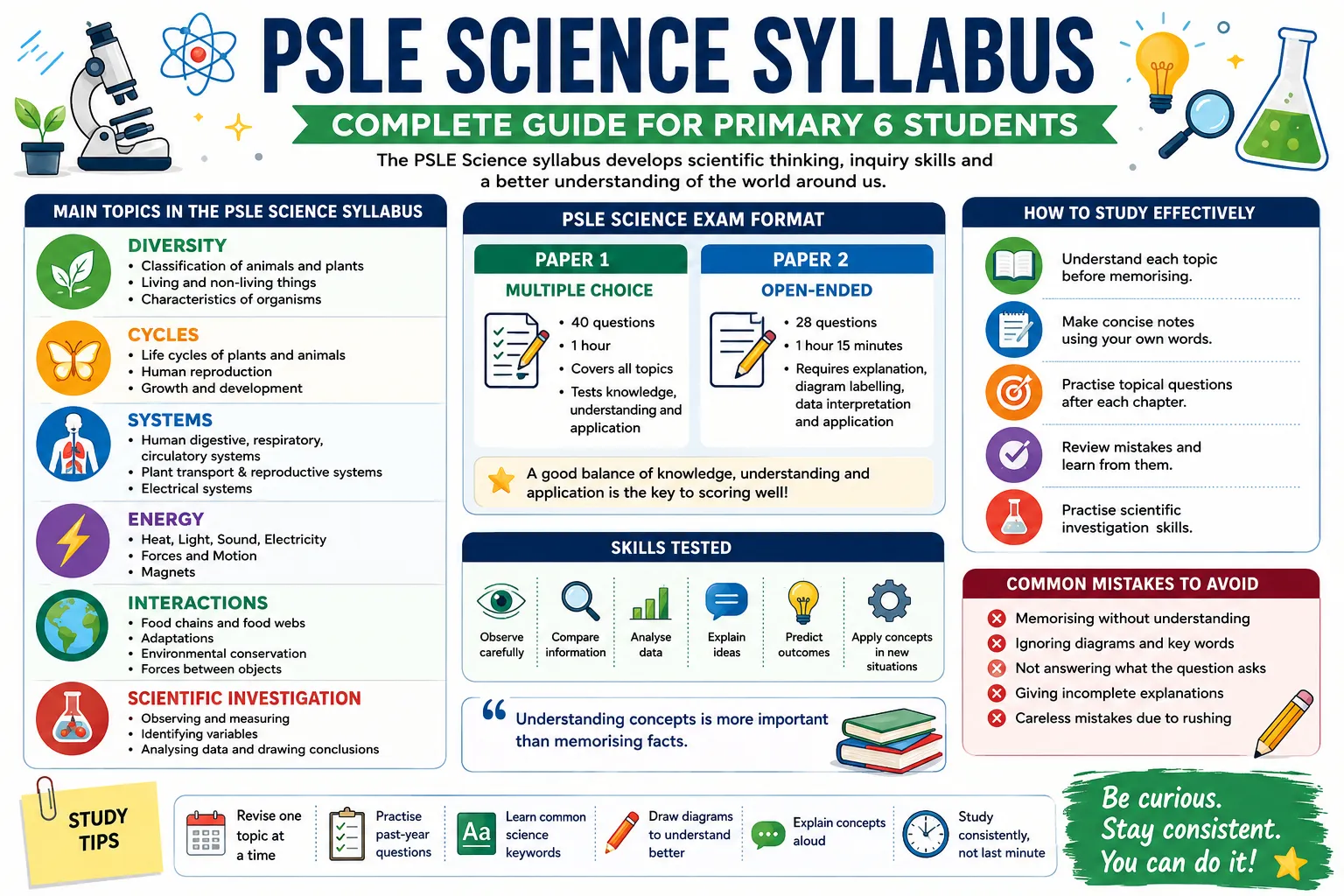

The PSLE Science syllabus is one of the most important parts of Primary School education in Singapore. It tests more than just facts. Students are expected to understand concepts, apply what they have learned, and explain their answers clearly.
Many parents think the PSLE Science syllabus is mainly about memorising notes. It isn’t. Students who understand the ideas behind each topic usually perform much better than those who only memorise definitions.
If you’re helping your child prepare for the PSLE, this guide covers everything you need to know. From the main topics to exam tips, you’ll get a clear picture of what to expect.
What Is the PSLE Science Syllabus?
The PSLE Science syllabus is designed by Singapore’s Ministry of Education to develop scientific thinking, observation skills, and problem-solving abilities.
Students learn how science works in everyday life. They explore living things, the environment, energy, forces, materials, and simple scientific investigations.
The exam doesn’t only ask “What is this?” It often asks “Why?” and “How?” That’s why understanding concepts matters so much.
Main Topics in the PSLE Science Syllabus
The PSLE Science syllabus is divided into several key themes.
Diversity
Students learn about different groups of living and non-living things.
Topics include:
- Classification of animals
- Classification of plants
- Living and non-living things
- Characteristics of organisms
Questions often test whether students can identify similarities and differences between different groups.
Cycles
This section focuses on natural life cycles and changes over time.
Students study:
- Life cycles of plants
- Life cycles of animals
- Human reproduction
- Growth and development
Understanding each stage—and knowing what changes happen—is very important.
Systems
The Systems section is one of the biggest parts of the PSLE Science syllabus.
Students learn about:
- Human digestive system
- Human respiratory system
- Human circulatory system
- Plant transport system
- Plant reproductive system
- Electrical systems
Many questions require students to explain how different parts work together.
Energy
Energy appears in many forms throughout the PSLE Science syllabus.
Students cover:
- Heat
- Light
- Sound
- Electricity
- Forces
- Magnets
They should understand how energy changes, moves, and affects everyday situations.
Simple experiments are also commonly tested.
Interactions
Interactions help students understand how objects and living things affect one another.
Topics include:
- Food chains
- Food webs
- Adaptation
- Environmental conservation
- Forces between objects
Questions often involve diagrams that require careful observation.
Scientific Investigation
This is an important skill-based section.
Students need to know how to:
- Observe carefully
- Compare results
- Identify variables
- Make predictions
- Draw conclusions
- Interpret experiment results
And this section isn’t difficult if students practise regularly.
PSLE Science Exam Format
The PSLE Science syllabus is assessed through two papers.
Paper 1
Paper 1 contains multiple-choice questions.
Students answer questions covering every topic in the syllabus.
These questions test:
- Basic knowledge
- Understanding
- Application
- Simple analysis
Many students lose marks by rushing. Reading every option carefully makes a big difference.
Paper 2
Paper 2 includes open-ended questions.
This paper requires students to:
- Explain answers
- Label diagrams
- Complete tables
- Interpret data
- Apply scientific concepts
Clear explanations are often worth more marks than short answers.
Skills Tested in the PSLE Science Syllabus
The PSLE Science syllabus focuses on much more than remembering facts.
Students are expected to:
- Observe carefully
- Compare information
- Analyse data
- Explain scientific ideas
- Predict outcomes
- Apply concepts in new situations
But many students spend too much time memorising instead of practising these skills.
Common Mistakes Students Make
Several mistakes appear every year.
Some students only memorise keywords without understanding the concepts.
Others ignore diagrams.
Some don’t answer exactly what the question asks.
Many also forget to include scientific keywords in open-ended answers.
These small mistakes can cost valuable marks.
How to Study the PSLE Science Syllabus Effectively
A smart study plan works better than long study hours.
Start by understanding each topic before trying to memorise details.
Create simple summary notes using your own words.
Practise topical questions after finishing every chapter.
Review mistakes instead of only checking correct answers.
And don’t ignore practical investigation questions. They appear regularly in exams.
Best Revision Tips
Here are some simple ways to prepare for the PSLE Science syllabus.
- Revise one topic at a time.
- Practise past-year questions every week.
- Learn common science keywords.
- Draw simple diagrams when revising.
- Explain concepts aloud.
- Review incorrect answers carefully.
- Study consistently instead of cramming before exams.
Small daily practice usually beats long weekend study sessions.
Why Understanding Matters More Than Memorising
The modern PSLE Science syllabus rewards understanding.
A question may describe a completely new situation.
Students who understand the science behind the topic can still answer correctly.
Those who only memorised textbook sentences often struggle.
That’s why teachers encourage concept-based learning instead of pure memorisation.
Final Thoughts
The PSLE Science syllabus may seem challenging at first, but it’s manageable with the right approach. Students who understand concepts, practise different question types, and revise consistently usually gain confidence as the exam gets closer.
The goal isn’t simply to score well. It’s also to build curiosity about how the world works. A strong understanding of the PSLE Science syllabus helps students not only in the PSLE but also in secondary school science.
Is the PSLE Science syllabus difficult?
The syllabus is manageable if students understand concepts, revise regularly, and practise different question types instead of relying only on memorisation.
Which topic is most important in the PSLE Science syllabus?
Every topic can appear in the examination. Students should prepare for all themes, especially Systems, Energy, Cycles, and Scientific Investigation.
How should students revise the PSLE Science syllabus?
The best approach is to revise topic by topic, practise past-year papers, review mistakes, and understand why each answer is correct.
Does the PSLE Science syllabus include experiments?
Yes. Students are tested on scientific investigation skills such as observation, identifying variables, interpreting results, and drawing conclusions.
How early should students start preparing?
Many students begin structured revision several months before the examination. Starting early allows enough time for practice, revision, and improving weaker topics without unnecessary stress.