
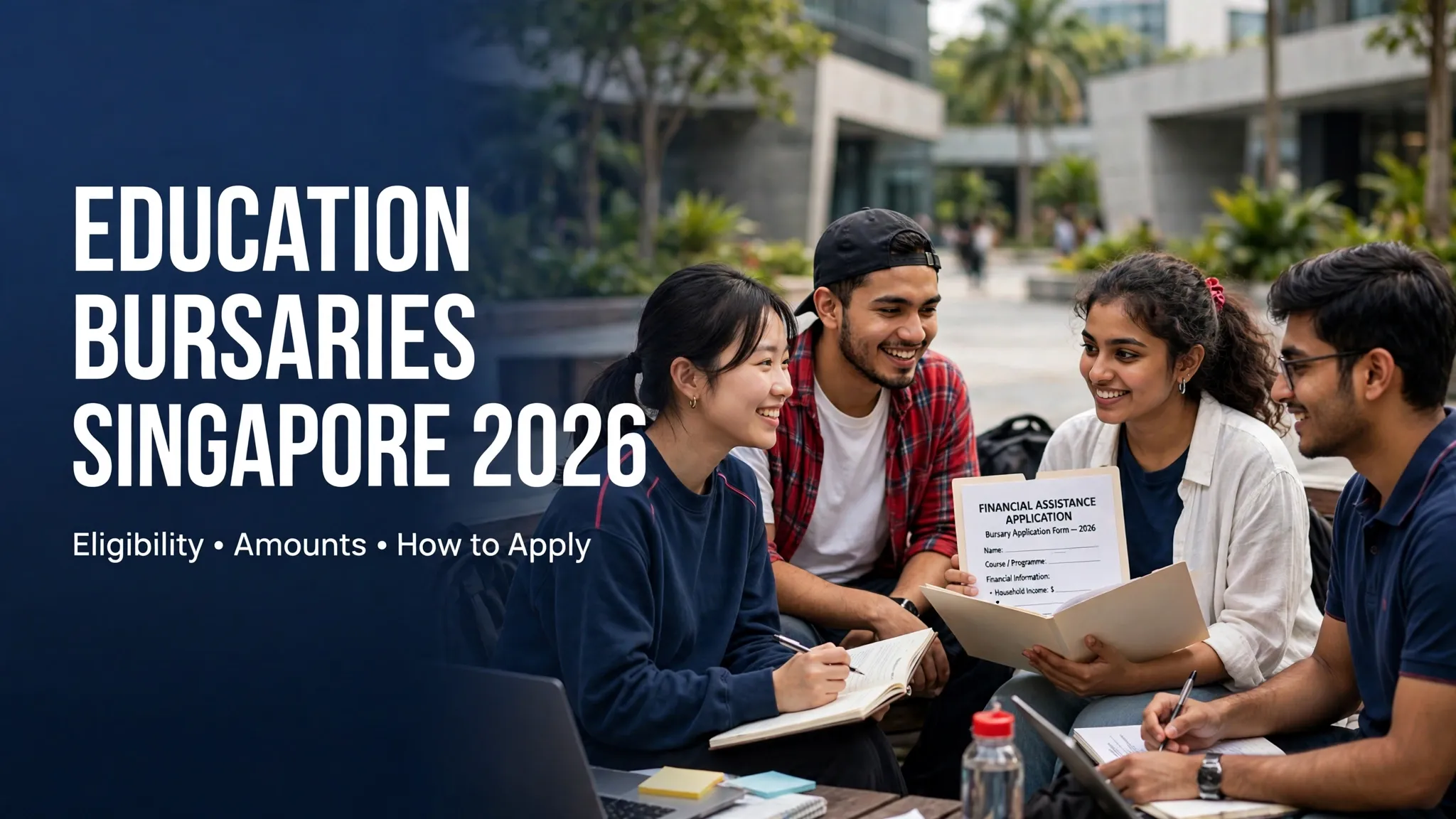

Education bursaries Singapore provide financial support to students from households that need help with education expenses. Government-funded schemes such as the Higher Education Community Bursary (HECB) and Higher Education Bursary (HEB) support eligible ITE, polytechnic and university students, while MOE Financial Assistance Scheme (FAS) helps school students. Eligibility depends on factors such as household income, citizenship, course and institution.
TL;DR – Education Bursaries Singapore
Education bursaries Singapore help eligible students manage school fees and other study expenses. HECB and HEB support qualifying students in ITE, polytechnics and universities, while MOE FAS assists eligible primary and secondary school students. Household income, citizenship, course type and institution rules determine eligibility and the amount awarded.
Types of Education Bursaries Available in Singapore
Singapore has government bursaries, school-level financial assistance and awards funded by education institutions or community organisations. The right scheme depends on where the student studies and the household’s financial circumstances.
Higher Education Community Bursary (HECB)

The Higher Education Community Bursary is for eligible Singapore Citizens enrolled in full-time, MOE-subsidised courses at ITE, polytechnics, arts institutions and autonomous universities. It provides financial support to students from lower-income households.
For AY2026, HECB has two income tiers. Students in Tier 1 may receive a higher annual bursary and, for eligible ITE Nitec and Higher Nitec students, a full tuition fee subsidy alongside the cash bursary. Tier 2 offers a lower annual amount. Applicants must also meet the relevant course and scholarship conditions.
Higher Education Bursary (HEB)
The Higher Education Bursary supports eligible students whose household income is above the HECB income bands but still falls within the HEB limits. It is available to qualifying full-time students in ITE, polytechnics and universities.
HEB also has two income tiers. A student may receive either HECB or HEB in the same academic year, not both. Full scholarship holders who already receive tuition fee coverage and a living allowance generally cannot hold these government bursaries at the same time.
MOE Financial Assistance Scheme (FAS)
MOE FAS is intended for eligible students in government and government-aided schools. It helps with school-related costs such as school fees, standard miscellaneous fees, textbooks and school attire. Eligible students may also receive transport or meal support, depending on the scheme’s benefits and assessment.
A parent or legal guardian submits the application through the Student Finance System. If a child does not qualify under the standard MOE criteria, parents can ask the school about school-based financial assistance.
Institution-Based and Community Bursaries
Universities and polytechnics may offer donor-sponsored bursaries, study grants and their own financial aid awards. Some are reserved for students in particular courses, while others consider household income, academic progress or personal circumstances.
Community organisations also provide education support. SINDA-SIET, for example, offers assistance under its own eligibility conditions. Permanent Residents and international students may find institution or donor-sponsored options even when they do not meet the citizenship rules for government bursaries.
Who Is Eligible for Education Bursaries in Singapore?
Eligibility is not identical across every scheme. Government higher education bursaries generally consider citizenship, full-time study, MOE subsidy status and household income. Institution-funded awards may set additional conditions.
Household Income Requirements – GHI and PCI
Two terms appear frequently in Singapore bursary applications: Gross Household Income (GHI) and Per Capita Income (PCI).
| Income term | Meaning |
|---|---|
| Gross Household Income (GHI) | Total gross monthly income of the household members included in the assessment |
| Per Capita Income (PCI) | Gross household income divided by the number of household members |
| HOMES | Household Means Eligibility System used to retrieve and assess household and income information |
The PCI formula is:
For example, if a household has a gross monthly income of $4,000 and four members, its PCI is $1,000. The household may fall within the HECB Tier 1 income threshold, subject to the scheme’s other requirements and the official household assessment.
HOMES can retrieve relevant household and income information for means-testing. Applicants should check the details shown during the application and provide further documents if requested.
Citizenship and Course Requirements

HECB and HEB are generally for Singapore Citizens taking eligible, full-time, MOE-subsidised courses. Students must also meet the relevant income limits and award conditions. A full scholarship that covers tuition fees and provides a living allowance can affect eligibility.
Singapore Permanent Residents and international students should check their institution’s financial aid pages for donor-sponsored or school-funded bursaries. These awards may have different citizenship and course rules.
How Much Can You Receive from Education Bursaries Singapore?
The annual bursary quantum depends on the scheme, household income tier and education level. The figures below are the government bursary amounts for eligible full-time students from Academic Year 2026. University amounts shown are general undergraduate figures; Medicine and Dentistry programmes may have different rates.
Government Bursary Amounts for AY2026
| Scheme and income tier | ITE students | Polytechnic students | University students |
|---|---|---|---|
| HECB Tier 1 | $1,850 + 100% tuition fee subsidy | $3,050 | $6,300 |
| HECB Tier 2 | $1,400 | $2,700 | $5,100 |
| HEB Tier 1 | $700 | $2,050 | $3,250 |
| HEB Tier 2 | $490 | $950 | $1,350 |
These are annual amounts, not monthly payments. The exact award and disbursement arrangements depend on the institution and the student’s course. From AY2026, some institutions disburse the bursary in two semester-based payments. Students should check their institution’s payment schedule and any outstanding fees.
Household Income Tiers for Government Bursaries
The following income bands apply to the full-time government bursary tiers from AY2026. The qualifying assessment uses GHI or PCI, rather than requiring both measures to fall within the stated band.
| Bursary tier | Monthly GHI | Monthly PCI |
|---|---|---|
| HECB Tier 1 | Up to $4,000 | Up to $1,000 |
| HECB Tier 2 | $4,001–$5,500 | $1,001–$1,375 |
| HEB Tier 1 | $5,501–$9,000 | $1,376–$2,250 |
| HEB Tier 2 | $9,001–$12,000 | $2,251–$3,000 |
These figures apply to the listed government bursary framework. School-level MOE FAS has its own eligibility criteria and benefits, so families should not use the HECB or HEB income table to assess school assistance.
Education Bursaries for Different Student Levels in Singapore
Financial support differs across education levels. A school student, ITE learner and university undergraduate will not necessarily apply through the same process.
Primary and Secondary School Students
Eligible students in government and government-aided schools can apply for MOE FAS. Support may cover school fees, miscellaneous fees, textbooks, school attire, meals and transport. Parents can submit an application through the Student Finance System or speak to the school about additional assistance.
ITE Students
Eligible full-time Singaporean ITE students can apply for HECB or HEB. ITE also offers other support, including the Monthly Financial Assistance Scheme (MFAS) for eligible daily living expenses and the Special Student Assistance Scheme (SSAS) for students facing short-term financial difficulties.
Polytechnic Students
Full-time Singapore Citizen students in eligible subsidised diploma courses may qualify for HECB or HEB. Polytechnics also list donor-sponsored bursaries and other awards. Check the financial aid section of the relevant polytechnic for application dates and course-specific conditions.
University Students
Undergraduates at autonomous universities and eligible arts institutions can check government bursaries alongside university-funded awards. NUS, NTU, SIT, SUTD and other institutions may have their own financial aid arrangements, with separate application periods and award conditions.
How to Apply for Education Bursaries in Singapore
The application route depends on the student’s school or institution. Start with its official financial aid page, as deadlines and online portals can differ.
Step-by-Step Bursary Application Process
-
Identify the bursary that matches your education level and course.
-
Check citizenship, household income and study requirements.
-
Review the application period for the current academic year.
-
Submit the financial aid application through the required online portal.
-
Review the household and income information retrieved for means-testing.
-
Upload any additional supporting documents requested.
-
Check the application status and follow the institution’s instructions about the award and payment.
Documents and Information You May Need
Keep relevant details ready before starting an application. Depending on the scheme, the institution may request:
-
NRIC or other identification details.
-
Information about household members.
-
Latest payslips or other employment income records.
-
Income tax assessment or self-employment income details.
-
Documents showing rental or other taxable income, where applicable.
-
Additional records requested by the school or financial aid office.
Not every applicant needs to upload every document. Some information may be retrieved through HOMES, while an institution may ask for extra proof if details are missing or need clarification.
Other Financial Assistance Options for Students
Bursaries are not the only form of student financial aid in Singapore. Eligible students may also check their Post-Secondary Education Account (PSEA), Edusave schemes and institution-funded study grants. ITE students facing financial pressure can ask about MFAS for monthly living support or SSAS for one-off help with urgent expenses.
These options have different rules. PSEA is an education savings account, Edusave awards have their own eligibility conditions, and bursaries are financial awards assessed under the relevant scheme. Students should check whether they can hold more than one form of assistance at the same time.
FAQs – Education Bursaries Singapore
1. Who qualifies for education bursaries in Singapore?
Eligibility depends on the bursary. Government HECB and HEB schemes generally support Singapore Citizens in eligible subsidised courses who meet the household income limits. Institution and community awards may have different conditions.
2. What is the income limit for MOE bursaries?
For full-time HECB and HEB schemes from AY2026, the monthly GHI limits range from $4,000 to $12,000, with matching PCI tiers. MOE FAS for school students uses separate criteria.
3. How much is the Higher Education Community Bursary?
For AY2026, HECB Tier 1 provides $1,850 plus a full tuition fee subsidy for eligible ITE Nitec and Higher Nitec students, $3,050 for diploma students and $6,300 for general undergraduates.
4. Can Singapore PR students apply for education bursaries?
PR students are generally not eligible for the Singapore Citizen government HECB and HEB schemes. They can check institution-funded and donor-sponsored bursaries, as some accept Permanent Residents.
5. Do students need to repay bursary money?
Bursaries are generally awards rather than education loans, so repayment is not normally required. However, an institution may require repayment in certain situations, such as withdrawal, dismissal or a change in sponsorship status.
6. Can students receive more than one bursary?
It depends on the award conditions. Students cannot receive HECB and HEB together in the same academic year, and full scholarship holders may be excluded. Check with the institution before accepting multiple awards.
Conclusion – Finding the Right Education Bursary in Singapore
Education Bursaries Singapore can help eligible students manage study costs at school, ITE, polytechnic and university level. Check the relevant scheme’s income limits, citizenship rules and application dates, then contact the school or institution’s financial aid office if anything is unclear.