
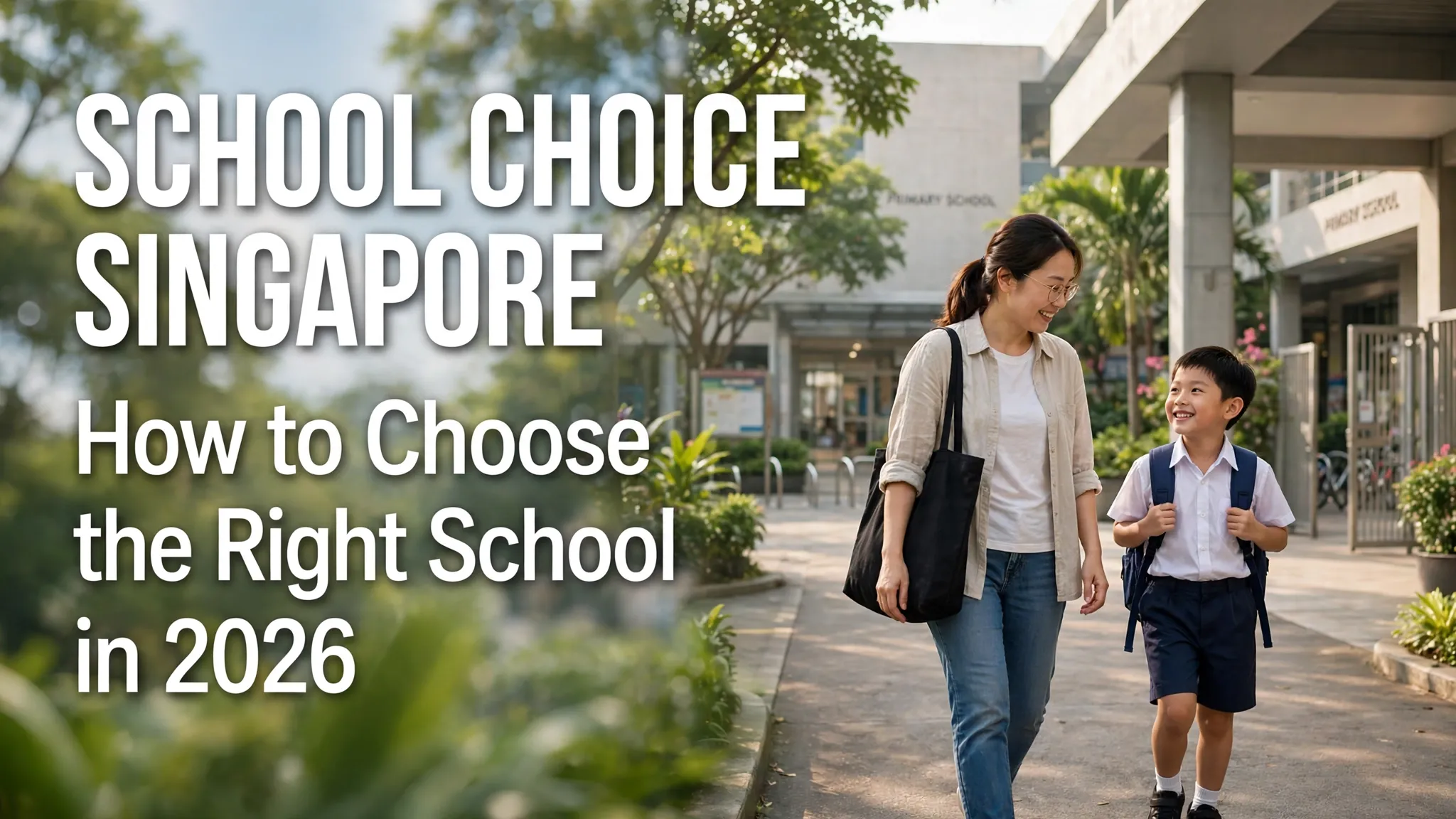

School Choice Singapore involves finding a school that suits a child’s learning needs, interests and family circumstances. Parents can consider government, government-aided, independent, private and international schools, each with different admission requirements, programmes and fees. But choosing a school isn’t just about academic results or reputation. Location, school culture, Co-Curricular Activities (CCAs) and the learning environment matter too. A good starting point is to compare suitable schools, understand the Singapore education system and check admission criteria before making a shortlist.
TL;DR – How to Choose a School in Singapore
To choose a school in Singapore, compare its curriculum, fees, location, admission requirements, CCAs and student support. Parents should also consider their child’s interests and learning needs, then use MOE SchoolFinder to research suitable options.
Types of Schools in Singapore
Singapore has several school types, and parents should understand their differences before making a shortlist.
1. Government Schools
Government schools are managed by the Ministry of Education (MOE) and follow the Singapore national curriculum. They offer primary and secondary education, with fees generally determined by the student’s residency status and education level.
2. Government-Aided and Independent Schools
Government-aided schools receive government funding but have their own management and school ethos. Independent schools have greater autonomy over areas such as programmes and fees. Parents should check each school’s admission requirements and curriculum before applying.
3. Private and International Schools
Private schools are independently operated, while international schools may offer programmes such as the International Baccalaureate (IB) or other overseas curricula. Their admission procedures and tuition fees can differ considerably.
| School type | Curriculum / management | What parents should check |
|---|---|---|
| Government | MOE-managed, Singapore curriculum | Admission and fees |
| Government-aided | Singapore curriculum, aided management | School ethos and programmes |
| Independent | Greater school autonomy | Fees and curriculum |
| Private | Institution-specific | Recognition and admission |
| International | IB or other curricula | Fees and eligibility |
School Fees in Singapore – What Should Parents Budget For?
School fees in Singapore depend on the school type, education level and student’s residency status. Government and government-aided schools follow MOE fee schedules, while independent and international schools set their own fees. Parents should also budget for uniforms, books, transport, meals and other school expenses.
For reference, the following are 2026 monthly fees for government and government-aided schools, including standard miscellaneous fees.
| Student category | Primary school | Secondary school |
|---|---|---|
| Singapore Citizen | S$13 | S$25 |
| Permanent Resident | S$343 | S$700 |
| International Student (ASEAN) | S$608 | S$1,111.80 |
| International Student (Non-ASEAN) | S$1,048 | S$2,211.80 |
Figures are in Singapore dollars. International student miscellaneous fees include GST. Additional charges may apply at autonomous schools. Independent and international school fees are not covered by this table.
Families can also check school-based financial assistance if fees are a concern. It’s worth asking the school about payment arrangements and other charges before accepting a place.
How to Choose the Right School in Singapore
A school’s reputation may catch a parent’s attention, but the day-to-day experience matters much more. These factors can help narrow down the options.
1. Consider Your Child’s Learning Needs
Think about your child’s academic strengths, interests and preferred learning environment. Some students enjoy a strong academic focus, while others may benefit from more practical learning, arts, sports or additional learning support. Look at the programmes offered and consider how they match your child’s interests.
2. Check Location and Transport
Home-school distance can affect a child’s daily routine, especially during the primary and secondary years. Check public transport options, travelling time and whether the journey involves multiple transfers. A school closer to home may make daily travel easier and leave more time for rest and activities.
3. Compare Programmes and CCAs
Co-Curricular Activities (CCAs) give students opportunities to take part in sports, performing arts, clubs and uniformed groups. Check the school’s Applied Learning Programme (ALP), Learning for Life Programme (LLP) and other activities. These can give parents a clearer picture of what students experience outside regular lessons.
4. Understand School Culture
School values, student well-being, discipline policies and teacher support all deserve attention. Parents can attend open houses, read school information and speak with school representatives. Ask about how the school supports students who need extra help, too.
Primary School Choice in Singapore – P1 Registration

Primary 1 Registration is the admission process for children entering mainstream primary schools. Singapore Citizens and Permanent Residents register through different phases, including Phase 1, 2A, 2B, 2C and 2C Supplementary, depending on eligibility. Home-school distance can affect admission priority, and balloting may apply when applications exceed available vacancies. School affiliation can also affect eligibility for certain phases. Parents should check the latest registration rules, vacancies and balloting information before selecting a school.
Secondary School Choice After PSLE
After receiving PSLE results, students and parents can shortlist secondary schools using the indicative PSLE Score ranges shown in MOE SchoolFinder. These ranges reflect the scores of students admitted in the previous year’s S1 Posting Exercise. They are references, not guaranteed admission scores.
Students can submit up to six secondary school choices in order of preference. Parents should compare each school’s programmes, ethos, CCAs and distance from home, rather than relying only on its Cut-Off Point (COP). Direct School Admission for secondary schools (DSA-Sec) is another route for students with strengths in areas such as sports, arts or specific academic fields. Full Subject-Based Banding (Full SBB) also gives students greater flexibility to take subjects at different levels according to their strengths.
Admission Pathways in Singapore Schools
Different students may enter schools through different admission routes. The applicable pathway depends on the child’s age, education level, eligibility and previous schooling.
| Admission pathway | Who it applies to |
|---|---|
| P1 Registration | Children entering Primary 1 |
| S1 Posting | Eligible students after PSLE |
| DSA-Sec | Students applying through specific talents |
| AEIS | Eligible international students seeking mainstream school admission |
The Admissions Exercise for International Students (AEIS) includes English and Mathematics assessments. Passing the assessment does not guarantee a school place; admission also depends on the outcome and available vacancies.
How to Use MOE SchoolFinder to Compare Schools
MOE SchoolFinder is a useful starting point for parents researching Singapore schools. You can search by location, check subjects and CCAs, review school programmes and look at indicative PSLE Score ranges for secondary schools. Use the information to prepare a shortlist, then check individual school details before making your choices. School websites and open houses can provide further information about their culture and activities.
Common School Selection Mistakes Parents Should Avoid
- Choosing a school based only on reputation or popularity.
- Treating previous PSLE cut-off points as guaranteed admission scores.
- Ignoring daily travelling time and transport options.
- Overlooking CCAs, school culture and student support.
- Using outdated fee schedules or admission information.
A little research before submitting an application can prevent confusion later.
Frequently Asked Questions
1. How do I choose the right school in Singapore?
Compare school fees, location, curriculum, admission eligibility, CCAs and student support. Choose options that suit your child’s learning needs and interests.
2. What are the different types of schools in Singapore?
Singapore has government, government-aided, independent, private and international schools. They differ in management, curriculum, admission rules and fees.
3. How much do schools cost in Singapore?
Government school fees depend on education level and residency status. Independent and international schools have their own fee schedules and additional charges.
4. How do parents choose secondary schools after PSLE?
Parents can compare indicative PSLE Score ranges, school programmes, CCAs, school culture and location before submitting up to six S1 Posting choices.
5. Is MOE SchoolFinder useful for choosing a school?
Yes. It provides school information, including location, subjects, programmes, CCAs and indicative PSLE Score ranges for secondary school selection.
Conclusion – Making the Right School Choice in Singapore
School Choice Singapore is about finding a suitable match for your child’s interests, learning needs and family budget. Compare school types, check admission requirements and consider the daily school experience before making a final selection.