
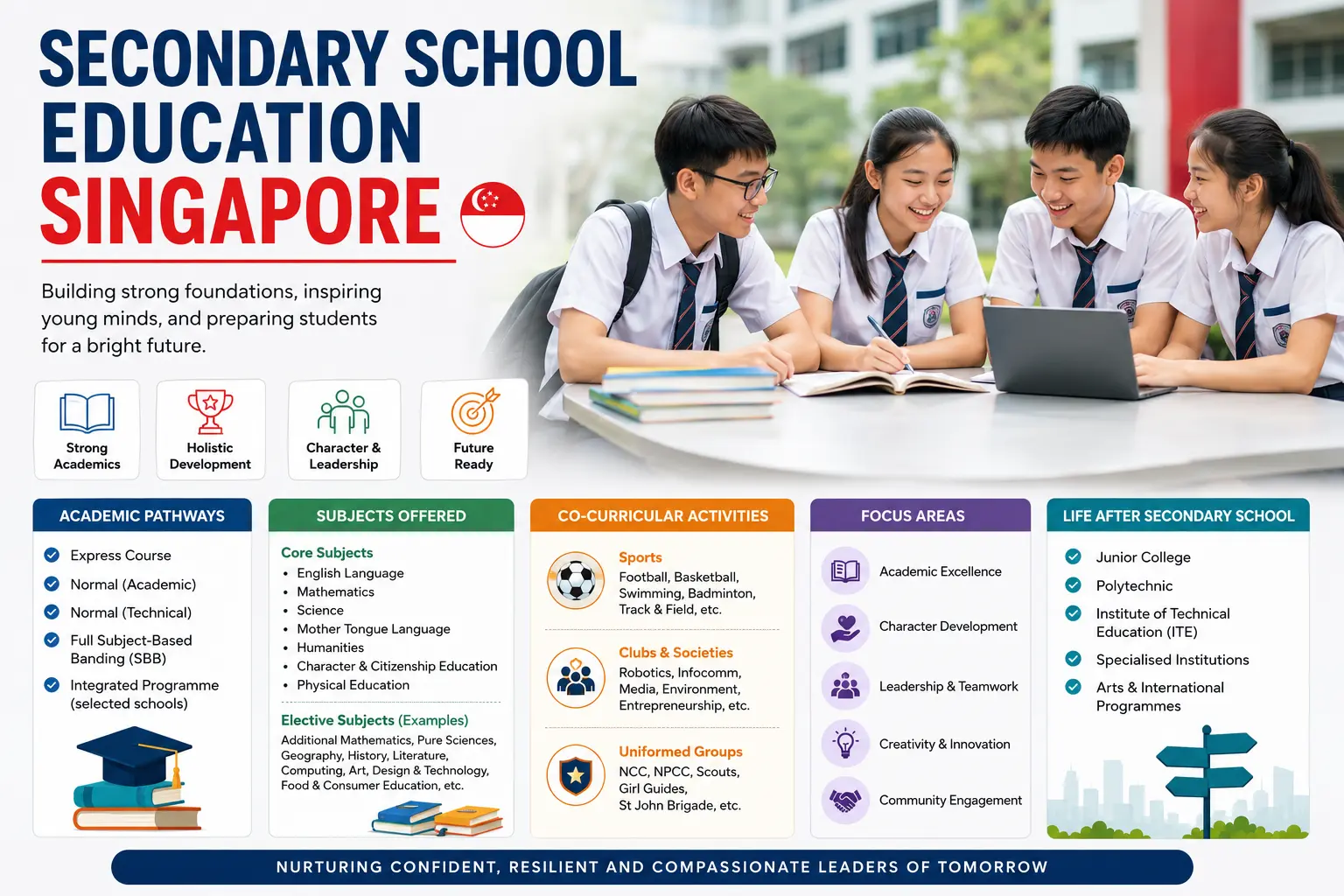

Starting Secondary School Education Singapore is a big step for every child. It marks the move from primary school into a more independent learning environment where students discover new interests, build stronger academic skills, and prepare for future education.
For many parents, this stage brings plenty of questions. Which school is the right choice? What subjects will students study? How important are CCAs? And what happens after secondary school?
The good news is that Secondary School Education Singapore is designed to support students with different strengths, interests, and learning styles. Every school follows a strong academic framework while also encouraging leadership, creativity, teamwork, and personal growth.
Let’s explore what makes Singapore’s secondary education system one of the most respected in the world.
1. Understanding Secondary School Education Singapore
Students usually begin Secondary School Education Singapore at around 12 or 13 years old after completing the PSLE. Most students spend four to five years in secondary school depending on their academic pathway.
During these years, students learn much more than textbooks.
They develop communication skills.
Critical thinking.
Problem-solving abilities.
Time management.
And perhaps most importantly… confidence.
Schools encourage students to become independent learners while preparing them for higher education and future careers.
2. Academic Pathways Available
One reason Secondary School Education Singapore works so well is its flexible learning pathways.
Students are placed into suitable courses based on their learning needs and academic strengths rather than forcing everyone into the exact same path.
Common pathways include:
- Express Course
- Normal (Academic)
- Normal (Technical)
- Full Subject-Based Banding options
- Integrated Programme (available in selected schools)
These pathways allow students to progress at a comfortable pace while still having opportunities to move between levels when they perform well.
This flexibility helps reduce unnecessary pressure while allowing students to reach their potential.
3. Core Subjects Students Study
The curriculum in Secondary School Education Singapore covers a wide range of subjects that help students build both academic knowledge and practical skills.
Core subjects usually include:
- English Language
- Mathematics
- Science
- Mother Tongue Language
- Humanities
- Character and Citizenship Education
- Physical Education
As students move into higher secondary levels, they can choose elective subjects based on their interests and future goals.
Popular options include:
- Additional Mathematics
- Pure Sciences
- Literature
- Geography
- History
- Design & Technology
- Art
- Food and Consumer Education
- Computing
- Principles of Accounts
This variety allows every student to create a learning journey that matches their abilities.
4. Learning Goes Beyond the Classroom
One of the biggest strengths of Secondary School Education Singapore is that learning doesn’t stop when lessons end.
Schools organise many activities throughout the year.
Students may participate in:
- Science projects
- Outdoor camps
- Community service
- Leadership programmes
- Educational trips
- Coding workshops
- Innovation competitions
- Cultural celebrations
These experiences help students become more confident and socially responsible.
Sometimes the biggest lessons aren’t learned from a textbook at all.
5. Co-Curricular Activities (CCA) Matter
CCA plays a major role in Secondary School Education Singapore.
Every student is encouraged to join at least one activity outside regular lessons.
Popular CCAs include:
Sports
- Football
- Basketball
- Volleyball
- Swimming
- Badminton
- Track and Field
Performing Arts
- Choir
- Dance
- Drama
- Concert Band
- Chinese Orchestra
Clubs
- Robotics
- Infocomm Club
- Photography
- Environmental Club
- Media Club
- Entrepreneurship Club
Uniformed Groups
- National Cadet Corps
- National Police Cadet Corps
- Scouts
- Girl Guides
- St John Brigade
CCA helps students build teamwork, discipline, leadership, and friendships that often last for years.
6. Character Development Is Equally Important
Academic success matters.
But Secondary School Education Singapore also focuses heavily on character building.
Schools encourage students to become:
- Respectful
- Responsible
- Honest
- Caring
- Resilient
- Self-disciplined
Character education is woven into everyday school life through classroom discussions, service-learning projects, leadership camps, and school events.
The goal isn’t simply producing students with high grades.
It’s about developing responsible citizens.
7. Technology Is Part of Everyday Learning
Classrooms across Secondary School Education Singapore have embraced technology in many ways.
Students regularly use digital platforms for:
- Homework
- Research
- Online quizzes
- Group discussions
- Digital presentations
- Learning resources
Teachers also use interactive tools that make lessons more engaging.
Digital literacy has become an important life skill, and schools prepare students to use technology responsibly and effectively.
8. Preparing for National Examinations
Secondary school eventually leads to important national examinations.
Preparation starts gradually instead of all at once.
Teachers monitor student progress through:
- Class assignments
- Practical work
- Projects
- Class tests
- Mid-year exams
- End-of-year examinations
Students receive continuous feedback so they know where they can improve.
Schools also provide revision programmes, consultation sessions, and additional support for students who need extra help.
9. Life After Secondary School
One exciting part of Secondary School Education Singapore is the many opportunities available after graduation.
Depending on their results and interests, students may continue to:
- Junior College
- Polytechnic
- Institute of Technical Education (ITE)
- Specialised institutions
- Arts schools
- International programmes
Each option offers different learning experiences and career pathways.
There isn’t just one route to success.
Students can choose the path that best suits their goals.
10. Tips for Success in Secondary School
Students can enjoy a much smoother journey by developing good habits early.
Some useful tips include:
- Create a regular study schedule.
- Complete homework on time.
- Stay organised with notes.
- Ask teachers questions whenever needed.
- Join a CCA that matches your interests.
- Balance study and rest.
- Read regularly to improve English.
- Revise consistently instead of cramming.
- Build healthy friendships.
- Stay curious and keep learning.
Small habits often lead to big improvements over time.
Why Parents Play an Important Role
Parents remain an important source of support throughout Secondary School Education Singapore.
Simple actions can make a big difference.
Talk with your child about school.
Celebrate progress instead of only focusing on grades.
Encourage healthy routines.
Support their interests.
Communicate with teachers whenever necessary.
Children usually perform better when school and home work together.
Common Challenges Students Face
Every student experiences challenges during secondary school.
Some struggle with heavier workloads.
Others find it difficult to adjust to new classmates or manage their time.
The key is not to panic.
Schools provide counselling services, academic support, peer mentoring, and teacher guidance to help students overcome difficulties.
With patience and consistent effort, most students settle into school life successfully.
Final Thoughts
Secondary School Education Singapore offers much more than academic learning. It helps students develop knowledge, confidence, discipline, leadership, and life skills that prepare them for the future.
From flexible learning pathways and diverse subject choices to exciting CCAs and character development programmes, the system gives students many opportunities to grow according to their strengths.
Every student’s journey is unique. Some excel in academics, others shine in sports, arts, leadership, or technology. What matters most is making steady progress, staying curious, and enjoying the learning experience along the way.
What is Secondary School Education Singapore?
Secondary School Education Singapore is the stage of education that follows primary school. Students usually attend secondary school for four to five years while preparing for higher education.
How long does secondary school last in Singapore?
Most students spend four years in the Express course or five years in other academic pathways, depending on their learning programme.
What subjects are taught in secondary school?
Students typically study English, Mathematics, Science, Mother Tongue, Humanities, Physical Education, and various elective subjects based on their interests.
Are Co-Curricular Activities compulsory?
Most schools strongly encourage students to participate in at least one CCA because it supports personal development, leadership, teamwork, and communication skills.
What can students do after completing secondary school?
After completing Secondary School Education Singapore, students may continue to Junior College, Polytechnic, ITE, specialised institutions, or other educational pathways based on their interests and academic results.