
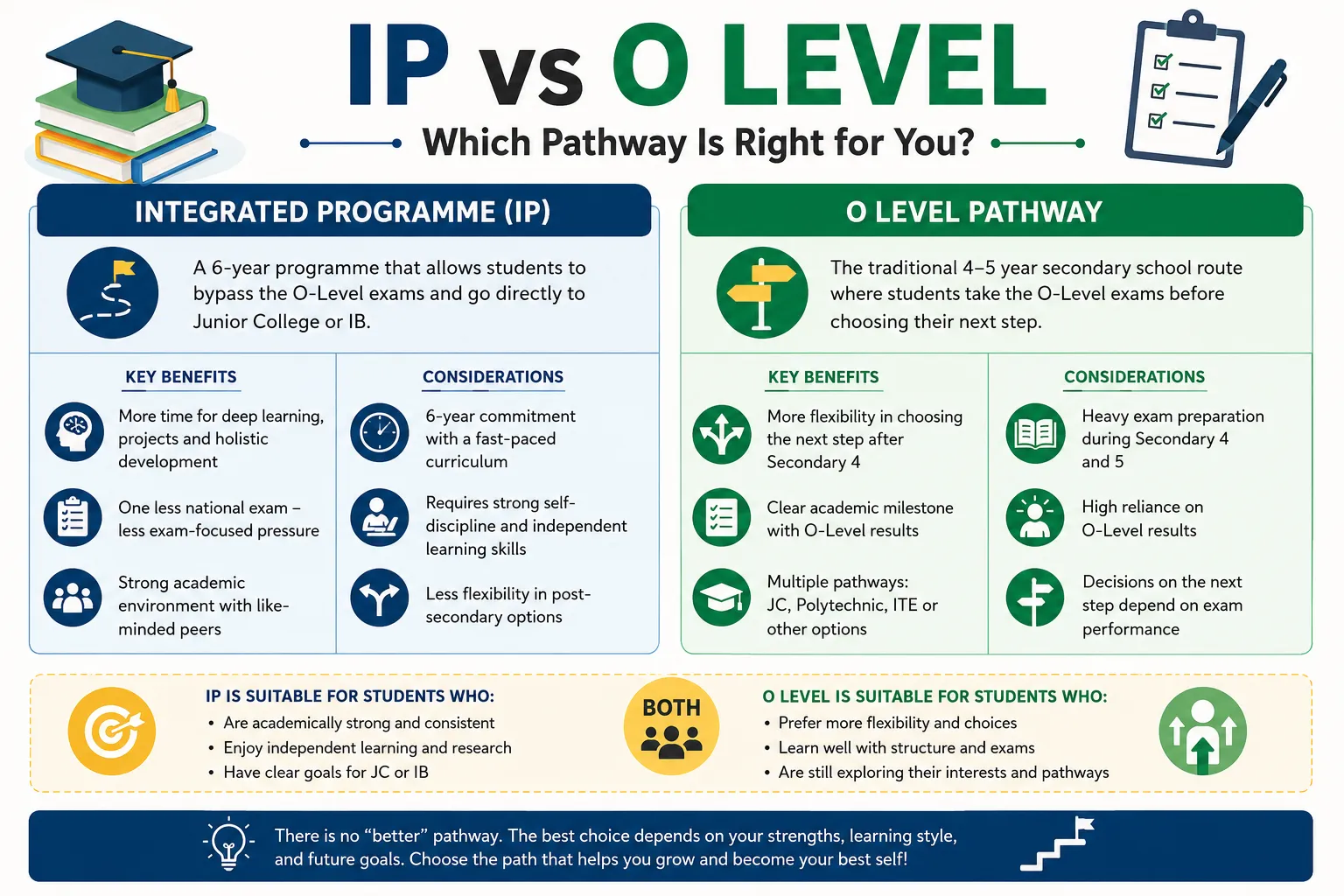

Choosing between IP vs O Level is one of the biggest decisions many students and parents face in Singapore. It can feel confusing at first. Both pathways offer good opportunities, but they are designed for different learning styles, academic goals, and future plans.
Some students do well in a fast-paced academic environment. Others perform better with structured milestones and national examinations. Neither option is better for everyone.
This guide explains IP vs O Level in simple words. You’ll learn how each pathway works, the main differences, the advantages, the disadvantages, and which option may suit different types of students.
What Is the Integrated Programme (IP)?
The Integrated Programme, often called IP, is a six-year education pathway offered by selected secondary schools and junior colleges in Singapore.
Students in the IP programme skip the GCE O-Level examinations after Secondary 4. Instead, they continue directly to Junior College or another pre-university programme before taking the A-Level examination or the International Baccalaureate (IB).
The main goal is simple. Students spend less time preparing for one major exam and more time exploring deeper learning, research projects, leadership activities, and critical thinking.
Many of Singapore’s top schools offer the Integrated Programme.
What Is the O-Level Pathway?
The O-Level pathway is the traditional secondary school route followed by most students in Singapore.
Students study for four or five years before taking the Singapore-Cambridge GCE O-Level examinations.
After completing O Levels, students have several choices, including:
- Junior College
- Polytechnic
- Institute of Technical Education (ITE)
- Private education institutions
This pathway gives students more flexibility because their next step depends on their O-Level results and personal interests.
IP vs O Level: Quick Comparison
| Feature | IP | O Level |
|---|---|---|
| National Exam After Secondary 4 | No | Yes |
| Programme Length | 6 Years | 4–5 Years |
| Main Goal | Direct path to JC or IB | Multiple education pathways |
| Learning Style | Independent and project-based | Structured and exam-focused |
| Flexibility | Lower | Higher |
| Suitable For | Strong academic students | Most students |
Why Do Some Students Choose IP?
Many families compare IP vs O Level because they want the best academic environment for their children.
The Integrated Programme offers several benefits.
More Time for Learning
Students don’t spend months preparing for O-Level examinations.
Instead, they can focus on:
- Research projects
- Leadership programmes
- Community service
- Overseas learning
- Advanced classroom discussions
This often creates a richer learning experience.
Less Exam Pressure
There is one less national examination.
That doesn’t mean IP is easy. Actually… many students find the programme more challenging because school assessments remain demanding.
Still, removing one major national exam allows students to learn beyond textbooks.
Strong Academic Environment
IP schools usually admit students with excellent PSLE results.
This means students learn alongside classmates who are highly motivated.
For some learners, that competitive environment encourages growth.
Why Do Many Students Still Choose O Levels?
When discussing IP vs O Level, it’s easy to focus only on the advantages of IP.
But the O-Level pathway remains an excellent choice for thousands of students every year.
More Educational Choices
One of the biggest strengths of O Levels is flexibility.
After completing the exams, students can choose:
- Polytechnic
- Junior College
- ITE
- Diploma programmes
- Overseas education pathways
Students don’t have to decide everything at age 12.
Their interests can develop naturally over time.
Clear Academic Milestones
The O-Level system gives students an important checkpoint.
Their examination results help them understand their academic strengths and areas for improvement before moving into higher education.
Many students actually perform much better than expected during O Levels.
Suitable for Different Learning Styles
Some students perform well when they have clear goals and structured examinations.
The O-Level pathway provides exactly that.
For students who prefer step-by-step learning, this system often works very well.
Key Differences Between IP vs O Level
Let’s look at the biggest differences.
Examination Structure
The biggest difference in IP vs O Level is the examination system.
IP students skip O Levels completely.
O-Level students take the national examination before choosing their next education pathway.
Learning Style
IP focuses more on:
- Critical thinking
- Independent learning
- Research
- Presentation skills
- Discussion-based lessons
O Levels place greater emphasis on:
- Subject mastery
- Examination preparation
- Academic consistency
- National assessment standards
Both approaches have value.
Academic Pace
IP generally moves faster.
Teachers often cover topics in greater depth.
Students are expected to learn independently and manage larger workloads.
The O-Level curriculum follows a more structured pace that suits a wider range of learners.
Is IP Harder Than O Level?
This is probably one of the most common questions.
The answer isn’t straightforward.
IP usually involves:
- More independent work
- More research assignments
- Higher classroom expectations
- Less focus on examination drilling
O Levels involve:
- Intensive examination preparation
- National assessment pressure
- Strong focus on academic results
Some students find IP harder because of the constant workload.
Others feel O Levels are more stressful because everything depends on one major examination.
It really depends on the student’s personality and learning style.
Who Should Choose IP?
The Integrated Programme may suit students who:
- Consistently achieve excellent academic results
- Enjoy learning beyond textbooks
- Like research and projects
- Are self-disciplined
- Plan to continue towards Junior College or IB
Students should also be comfortable managing their own learning.
That part is often overlooked.
Who Should Choose O Levels?
The O-Level pathway may be a better fit for students who:
- Want more flexibility after Secondary 4
- May consider Polytechnic
- Prefer structured learning
- Perform well in examinations
- Are still exploring future career interests
And that’s completely normal.
Not every student knows what they want at age 12 or 13.
The O-Level route leaves more doors open.
Common Misunderstandings About IP vs O Level
Many parents believe IP students are guaranteed better university opportunities.
That’s not true.
Universities look at overall academic performance, personal achievements, interviews, portfolios, and many other factors.
Another myth is that O-Level students cannot succeed academically.
Again, that’s false.
Many top university students, scholarship winners, and professionals completed the traditional O-Level pathway before entering Junior College or Polytechnic.
Success depends far more on effort than the programme itself.
Final Thoughts on IP vs O Level
Choosing between IP vs O Level isn’t about finding the “better” programme. It’s about finding the right fit.
The Integrated Programme offers deeper learning, fewer national examinations, and a direct path to pre-university education. It’s ideal for students who enjoy academic challenges and independent learning.
The O-Level pathway provides flexibility, recognised national qualifications, and multiple education options after Secondary 4. It remains the preferred choice for many successful students in Singapore.
Take time to understand your child’s strengths, learning habits, interests, and long-term goals. The right decision today can make the learning journey much more enjoyable in the years ahead.
Which is better, IP or O Level?
Neither is better for every student. IP suits academically strong students who prefer independent learning, while O Levels provide greater flexibility and multiple education pathways.
Can IP students take O Levels?
Generally, students in the Integrated Programme do not take the GCE O-Level examinations because they progress directly to pre-university education.
Is it easier to enter university through IP?
There is no guaranteed advantage. University admission depends on academic performance, achievements, and admission requirements rather than whether a student completed IP or O Levels.
Can O-Level students enter Junior College?
Yes. Students with strong O-Level results can enter Junior Colleges and continue towards the GCE A-Level examinations.
Should parents choose IP for their child?
Parents should consider their child’s academic ability, learning style, interests, and future goals instead of choosing a programme based only on reputation.