

Writing an informal message sounds easy… until you’re actually asked to do it.
Many students know what they want to say but struggle to organize their ideas in a natural way. They either sound too formal or leave out important details. That’s where good informal situational writing examples become useful.
The good thing? Once you understand the basic format, writing becomes much easier. You don’t need difficult words or fancy sentences. You just need to write like you’re talking to someone you know well while making sure all the required information is included.
In this guide, you’ll find several informal situational writing examples, practical tips, and common mistakes to avoid.
What Is Informal Situational Writing?
Informal situational writing is a short piece of writing where you communicate with someone you know personally. This could be your friend, cousin, sibling, classmate, or another family member.
Unlike formal writing, the tone is friendly and relaxed. You can use simple language, contractions like “I’m” or “can’t,” and natural expressions.
Most school tasks ask students to write:
- Emails
- Text messages
- Notes
- Invitations
- Letters
- WhatsApp-style messages
The goal isn’t to sound professional. It’s to communicate clearly and naturally.
Why Students Practice Informal Situational Writing
Schools use informal situational writing because it reflects real-life communication.
Think about it…
Every day, people send messages, invite friends, thank relatives, apologize, or share exciting news. These everyday situations help students learn how to express themselves clearly.
By studying different informal situational writing examples, students also improve their vocabulary, sentence flow, and confidence.
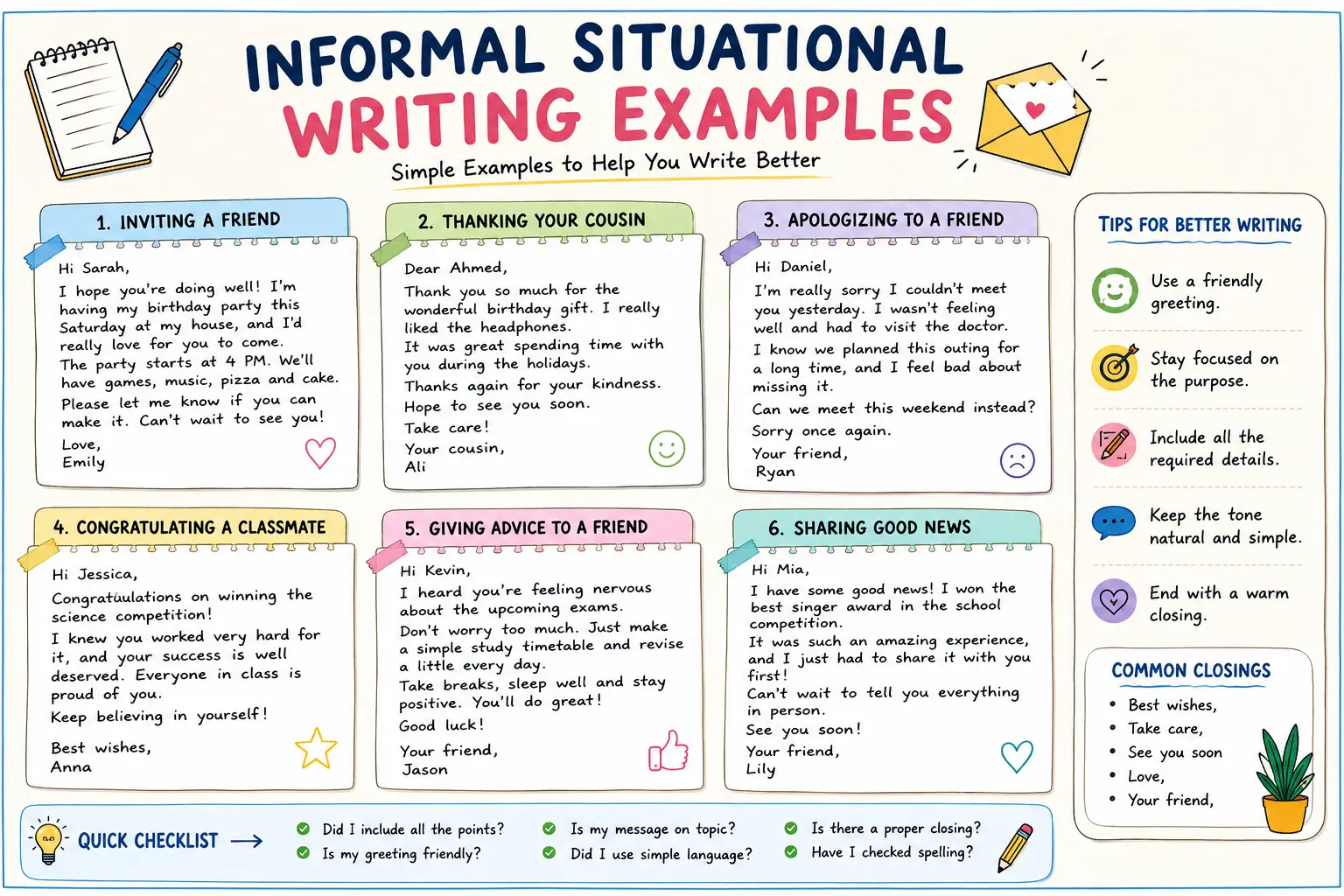
Example 1: Inviting a Friend to Your Birthday Party
Hi Sarah,
I hope you’re doing well! I’m having my birthday party this Saturday at my house, and I’d really love for you to come.
The party starts at 4 PM, and we’ll have games, music, pizza, and cake. Some of our classmates will be there too, so it’ll be a lot of fun.
Please let me know if you can make it. I can’t wait to celebrate with you!
See you soon!
Love,
Emily
Example 2: Thanking Your Cousin
Dear Ahmed,
Thank you so much for the wonderful birthday gift. I really liked the headphones you gave me. I’ve already started using them every day.
It was also great spending time with you during the holidays. We had so much fun playing games and watching movies together.
Thanks again for your kindness. Hope to see you soon.
Take care!
Your cousin,
Ali
Example 3: Apologizing to a Friend
Hi Daniel,
I’m really sorry I couldn’t meet you yesterday. I wasn’t feeling well and had to visit the doctor with my parents.
I know we planned this outing for a long time, and I feel bad about missing it.
Can we meet this weekend instead? I’ll make sure nothing comes in the way this time.
Sorry once again.
Your friend,
Ryan
Example 4: Congratulating a Classmate
Hi Jessica,
Congratulations on winning the science competition!
I knew you worked very hard for it, and your success is well deserved. Everyone in class is proud of you.
Keep believing in yourself because I’m sure you’ll achieve even bigger things in the future.
Best wishes!
Your friend,
Anna
Example 5: Giving Advice to a Friend
Hi Kevin,
I heard you’re feeling nervous about the upcoming exams.
Don’t worry too much. Just make a simple study timetable and revise a little every day instead of trying to finish everything at once.
Take short breaks, sleep well, and don’t forget to stay positive. You’ve prepared well, and I’m sure you’ll do great.
Good luck!
Your friend,
Jason
Tips for Writing Better Informal Situational Writing
Reading many informal situational writing examples helps, but following a few simple rules makes an even bigger difference.
Use a Friendly Greeting
Start naturally.
Examples include:
- Hi Alex,
- Dear Emma,
- Hello Ryan,
Avoid greetings that sound too official unless your teacher asks for them.
Stay Focused
Only write about the purpose of the message.
If you’re inviting someone to a party, don’t suddenly start talking about your holiday unless it’s connected to the invitation.
Simple and clear always works better.
Include All Required Details
Many questions provide points that must be included.
Read the instructions carefully before writing.
Missing one required detail can cost marks even if your writing is excellent.
Keep the Tone Natural
You’re writing to someone you know.
Use everyday expressions like:
- I hope you’re doing well.
- Can’t wait to see you.
- Thanks a lot.
- Hope everything is going great.
These make your writing feel genuine.
End Politely
Finish with a warm closing.
Some common endings are:
- Best wishes,
- Love,
- Take care,
- See you soon,
- Your friend,
Choose one that matches the situation.
Common Mistakes Students Make
Even after reading many informal situational writing examples, students often repeat the same errors.
Some of the most common ones include:
- Writing long and complicated sentences.
- Forgetting the greeting.
- Missing important information.
- Using overly formal language.
- Repeating the same idea several times.
- Ending the message without a proper sign-off.
- Ignoring the purpose of the writing.
Keeping things simple usually gives better results.
Quick Checklist Before You Submit
Before handing in your work, ask yourself these questions:
- Did I include all the required points?
- Is my greeting friendly?
- Does my message stay on topic?
- Did I use simple, natural language?
- Is there a proper closing?
- Have I checked my spelling and grammar?
Just spending one extra minute checking your work can improve your final score.
How to Practice Informal Situational Writing
Practice doesn’t have to be difficult.
Try writing one short message every day.
You can pretend you’re:
- Inviting a friend.
- Thanking a teacher.
- Congratulating a cousin.
- Asking for help.
- Giving advice.
- Apologizing.
- Sharing good news.
The more informal situational writing examples you create yourself, the easier exams become.
And don’t worry if your first few attempts aren’t perfect. Every good writer improves through practice.
Conclusion
Learning from different informal situational writing examples is one of the fastest ways to improve your writing skills. They show you how real conversations are written while helping you understand the correct structure and tone.
Keep your language simple, include every required detail, and write naturally. You don’t need impressive vocabulary to score well. Clear ideas, friendly expressions, and good organization matter much more.
With regular practice, informal situational writing will start to feel easy—and maybe even enjoyable.
What is informal situational writing?
Informal situational writing is a friendly piece of writing addressed to someone you know, such as a friend or family member. It may take the form of an email, letter, note, or message.
Why are informal situational writing examples important?
Informal situational writing examples help students understand the correct format, tone, and structure while improving their confidence and writing skills.
How long should informal situational writing be?
The required length depends on your school or exam instructions. Most tasks are short and focus on including all the important details clearly.
What language should I use?
Use simple, friendly, and natural language. Imagine you’re speaking politely to someone you know well.
Can I use contractions in informal writing?
Yes. Words like “I’m,” “don’t,” “can’t,” and “you’re” are perfectly suitable because the tone is informal and conversational.