

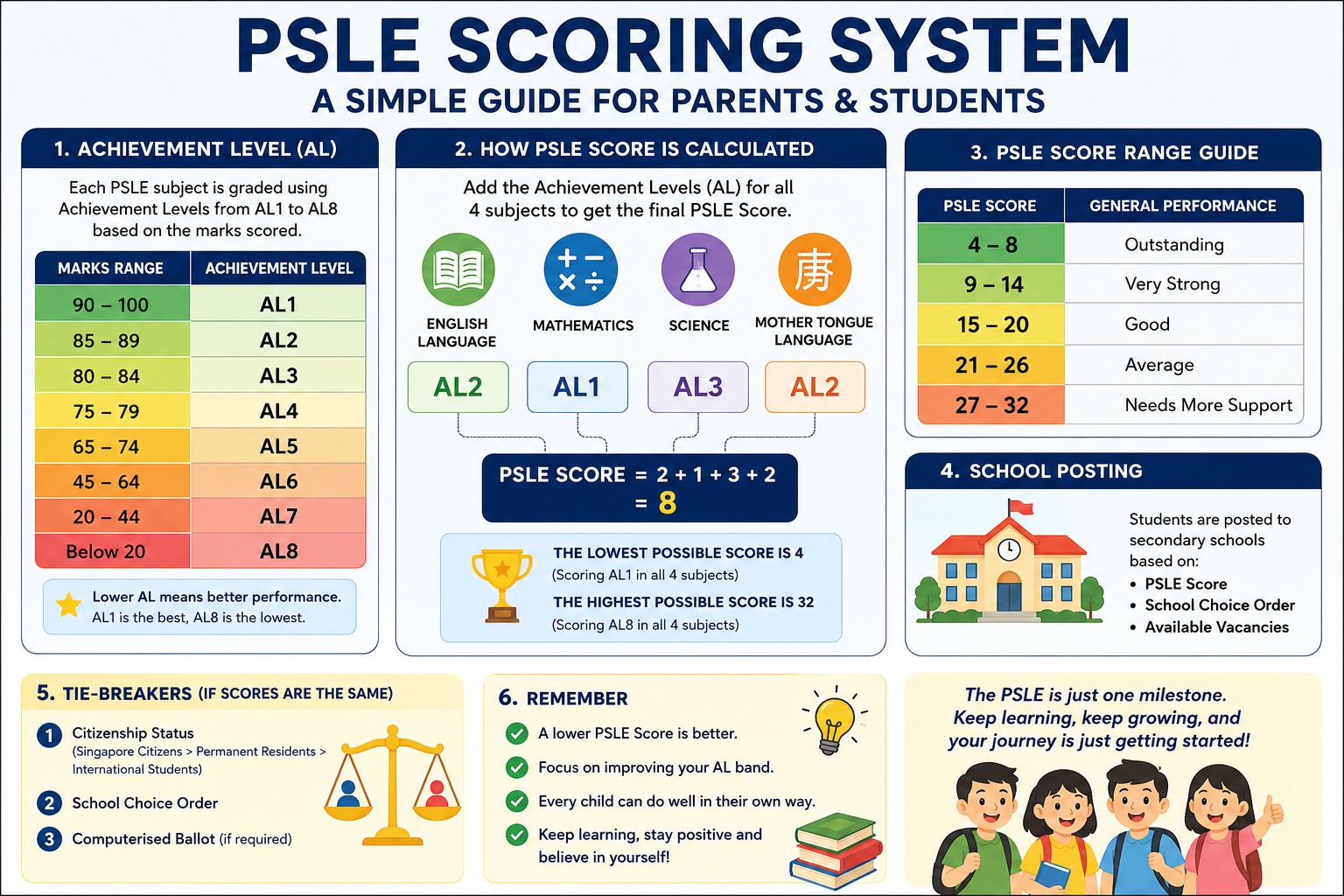
If you’re trying to understand the PSLE scoring system, you’re definitely not alone. Every year, thousands of parents in Singapore search for a clear explanation because the system looks confusing at first. Terms like Achievement Levels (AL), PSLE Score, school posting, and tie-breakers can leave anyone scratching their head.
The good news? Once you know how the scoring works, it actually makes a lot of sense.
This guide explains everything in plain English—without complicated education jargon. Whether your child is taking the PSLE this year or you’re simply planning ahead, here’s what you need to know.
What Is the PSLE Scoring System?
The PSLE scoring system is the method used to calculate a student’s Primary School Leaving Examination results. Instead of ranking students against one another using the old T-score system, Singapore now uses Achievement Levels (ALs).
This change was introduced to reduce unnecessary competition and encourage students to focus on their own learning instead of comparing themselves with classmates.
Every student receives an Achievement Level for each subject:
- English Language
- Mathematics
- Science
- Mother Tongue Language
These four Achievement Levels are added together to form the final PSLE Score.
A lower score is better.
That’s probably the biggest thing to remember.
How Achievement Levels (ALs) Work
Each subject is graded using Achievement Levels ranging from AL1 to AL8.
Here’s how they correspond to examination marks.
| Marks | Achievement Level |
|---|---|
| 90–100 | AL1 |
| 85–89 | AL2 |
| 80–84 | AL3 |
| 75–79 | AL4 |
| 65–74 | AL5 |
| 45–64 | AL6 |
| 20–44 | AL7 |
| Below 20 | AL8 |
A student who scores 91 in Mathematics receives AL1.
Another student who scores 96 also receives AL1.
This means tiny mark differences no longer separate students dramatically like they did under the old T-score system.
And honestly, that’s one of the biggest reasons many parents appreciate the new approach.
How the Final PSLE Score Is Calculated
Calculating the final PSLE scoring system result is surprisingly straightforward.
Simply add the Achievement Levels from all four subjects.
Example
| Subject | Achievement Level |
| English | AL2 |
| Mathematics | AL1 |
| Science | AL3 |
| Mother Tongue | AL2 |
Final PSLE Score:
2 + 1 + 3 + 2 = 8
The student’s final PSLE Score is 8.
Remember…
The lowest possible score is 4, while the highest is 32.
A score of 4 means the student achieved AL1 in every subject.
Why the PSLE Scoring System Changed
The previous T-score system ranked students very precisely.
Sometimes just one or two marks could significantly affect secondary school placement. That created unnecessary pressure for many families.
The updated PSLE scoring system was introduced to:
- Reduce excessive academic competition
- Encourage meaningful learning
- Focus on individual achievement
- Reduce stress caused by tiny mark differences
- Give students a broader scoring band
It’s less about chasing every single mark.
Instead, students are encouraged to aim for the next Achievement Level.
Secondary School Posting
After receiving their PSLE results, students use their scores to apply for secondary schools.
Schools admit students based primarily on:
- PSLE Score
- School choice order
- Available vacancies
Students with stronger PSLE Scores generally have access to more school options.
Still, choosing schools wisely matters just as much.
Many parents make the mistake of applying only to highly competitive schools without considering realistic backup choices.
What Happens If Two Students Have the Same Score?
It happens every year.
Several students often receive identical PSLE Scores.
When this occurs, Singapore uses tie-breakers.
These include:
- Citizenship status
- Choice order of schools
- Computerised ballot if necessary
Singapore Citizens receive priority over Permanent Residents and international students during school posting.
After that, school preference order becomes important.
So yes… listing schools carefully can make a real difference.
What Is Considered a Good PSLE Score?
There’s no single “perfect” score because every student has different goals.
Still, here’s a general guide.
| PSLE Score | General Performance |
| 4–8 | Outstanding |
| 9–14 | Very Strong |
| 15–20 | Good |
| 21–26 | Average |
| 27–32 | Needs More Support |
Keep in mind that secondary school cut-off points change slightly each year depending on student applications.
That’s why parents shouldn’t rely only on previous years’ figures.
Subject Combination Matters Too
While the PSLE scoring system determines secondary school placement, schools also consider suitable academic pathways.
Students may enter different course options depending on their overall performance.
These pathways are designed to match different learning needs rather than label students.
The goal is to help every child succeed at a pace that’s comfortable for them.
Tips for Students Preparing for PSLE
Scoring well isn’t only about studying longer.
Smart preparation often works better.
Here are a few practical ideas.
Focus on Achievement Levels
Instead of worrying about getting every question perfect, aim to move into the next AL band.
Sometimes improving by just a few marks can improve your Achievement Level.
Practice Past Papers
Past-year examination papers help students understand question styles and manage time better.
Consistency usually beats last-minute cramming.
Build Strong Foundations
Subjects like Mathematics and Science often require concepts learned over several years.
Reviewing earlier topics can strengthen overall performance.
Don’t Ignore English
English affects every student’s overall PSLE Score.
Reading regularly, improving vocabulary, and practising comprehension can make a noticeable difference.
Stay Healthy
Enough sleep, balanced meals, and regular breaks matter more than many students realise.
A tired brain struggles during examinations.
Common Misunderstandings About the PSLE Scoring System
A few myths still circulate among parents.
Let’s clear them up.
Higher Marks Always Mean Better School Posting
Not necessarily.
Students are grouped into Achievement Levels.
Scoring 92 instead of 98 doesn’t improve the Achievement Level because both receive AL1.
Every Mark Matters Equally
Only if it changes your Achievement Level.
Crossing from AL3 to AL2 is more meaningful than increasing marks within the same band.
Students Compete Against Classmates
No.
Achievement Levels measure individual performance rather than ranking students against one another.
That’s one of the biggest differences from the previous system.
Final Thoughts
Understanding the PSLE scoring system doesn’t have to be stressful. Once you know how Achievement Levels work, the process becomes much easier to follow.
Instead of comparing children based on tiny mark differences, the current system rewards broader achievement and encourages healthier learning habits. Students can focus on improving their own performance rather than worrying about every competitor around them.
For parents, the best approach is simple: understand the scoring bands, support consistent study habits, and help children stay confident throughout their preparation. After all, the PSLE is an important milestone—but it’s only one step in a much longer educational journey.

,%20score%20calculation,%20school%20posting,%20and%20tips%20for%20parents.)