

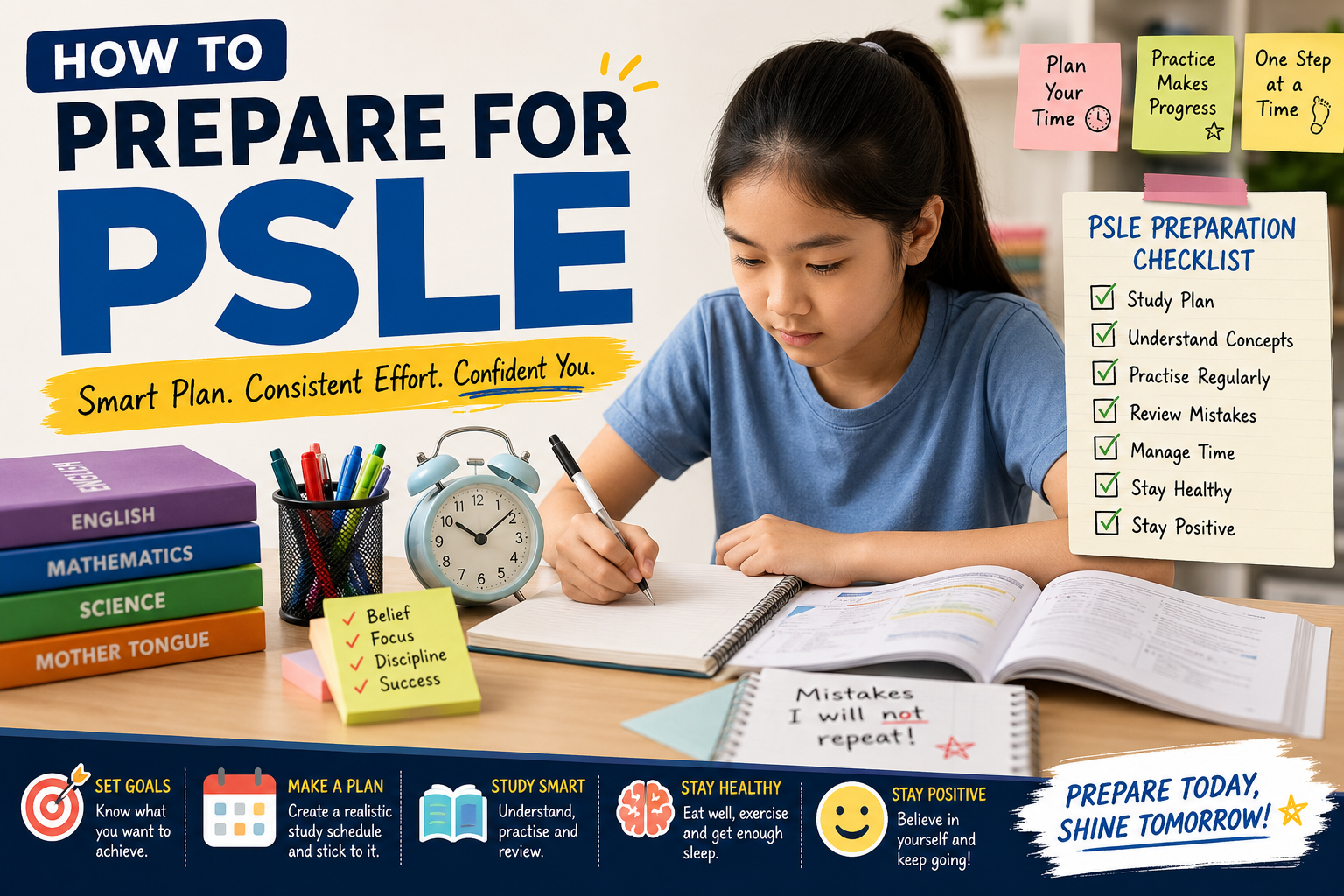
The Primary School Leaving Examination (PSLE) is a major milestone for every student in Singapore. It can feel exciting, stressful, and even a little overwhelming at times. Parents often wonder if their child is studying enough. Students worry about getting the scores they hope for.
The good news? Knowing how to prepare for PSLE isn’t about studying every waking hour. It’s about following a smart plan, staying consistent, and keeping a healthy balance between learning and rest.
If you’re looking for realistic advice that actually works, these tips can help you prepare with confidence.
1. Understand the PSLE Format First
Before opening another assessment book, spend some time understanding what you’re preparing for.
Every subject has its own format, question styles, and marking approach. Students who know what to expect usually feel much more comfortable during the actual exam.
Look through:
- Past-year papers
- School examination papers
- Practice booklets
- Sample questions
The exam becomes much less intimidating once it feels familiar.
2. Create a Weekly Study Schedule
One of the biggest mistakes students make is studying only when exams are close.
A simple weekly timetable works much better.
You don’t need to study six hours every day. Even two or three focused sessions after school can make a noticeable difference over several months.
Try rotating subjects instead of studying the same one repeatedly.
For example:
- Monday – English
- Tuesday – Mathematics
- Wednesday – Science
- Thursday – Mother Tongue
- Friday – Review weak topics
Small daily progress adds up surprisingly fast.
3. Focus on Weak Subjects Without Ignoring Strong Ones
It’s natural to spend more time on subjects you enjoy.
But PSLE rewards balanced performance.
If Mathematics is your weakest subject, give it extra attention. At the same time, don’t stop practising English or Science just because you’re already scoring well.
Strong subjects can drop if they aren’t maintained.
A balanced approach usually produces better overall results.
4. Practise Under Exam Conditions
Reading notes feels productive.
Actually answering questions is far more useful.
Set a timer and complete full practice papers without checking answers halfway through.
This helps you:
- Improve speed
- Build concentration
- Learn time management
- Reduce exam anxiety
Many students discover that finishing the paper on time is harder than expected.
It’s much better to find that out during practice.
5. Review Mistakes Carefully
Finishing ten practice papers means very little if you never review them.
The correction process is where real improvement happens.
Ask yourself:
- Why did I get this wrong?
- Did I misunderstand the question?
- Was it careless?
- Did I forget a concept?
Keep a notebook of common mistakes.
Reading through those pages before exams is often more valuable than completing another assessment book.
6. Read Every Day
Reading is one of the easiest ways to improve English naturally.
You don’t have to read difficult novels.
Newspapers, children’s magazines, informative websites, and age-appropriate books all help expand vocabulary and improve comprehension skills.
Even twenty minutes each day can make a noticeable difference over several months.
And yes… reading also improves writing without students even realizing it.
7. Build Strong Math Foundations
Many PSLE Mathematics questions test understanding rather than memorization.
Students should master:
- Fractions
- Decimals
- Percentages
- Ratios
- Word problems
- Model drawing
Don’t rush through difficult questions.
Slowly understanding one challenging problem is often better than quickly solving ten easy ones.
Confidence grows with practice.
8. Don’t Memorize Science Blindly
Science isn’t just about remembering facts.
Many questions require students to apply concepts in unfamiliar situations.
Instead of memorizing entire chapters, understand:
- Why something happens
- How systems work
- Relationships between concepts
- Scientific reasoning
Drawing simple diagrams can also help make difficult topics easier to remember.
9. Ask Questions Early
Many students wait until the last month before asking for help.
That usually creates unnecessary stress.
If a topic feels confusing today, ask your teacher, parent, tutor, or classmate.
Clearing one doubt immediately prevents bigger problems later.
There’s absolutely nothing wrong with asking questions.
In fact, students who ask questions regularly often improve faster.
10. Take Care of Your Health
A tired brain doesn’t learn very well.
Students preparing for PSLE sometimes sacrifice sleep to study longer.
That usually backfires.
Instead, aim for:
- Regular sleep
- Healthy meals
- Plenty of water
- Short exercise breaks
- Limited screen distractions
Your brain performs much better when your body is well rested.
Simple… but often overlooked.
11. Stay Calm Before the Exam
The final few days aren’t the time to learn completely new topics.
Focus on revision instead.
Go through:
- Summary notes
- Formula sheets
- Common mistakes
- Vocabulary lists
- Previous corrections
Avoid comparing your preparation with friends.
Everyone studies differently.
The goal isn’t perfection.
It’s walking into the exam feeling prepared.
12. Believe in the Work You’ve Already Done
Confidence matters.
Students sometimes panic because they think they haven’t done enough.
But if you’ve been following a consistent study routine for months, trust your preparation.
During the exam:
- Read questions carefully.
- Manage your time.
- Don’t spend too long on one difficult question.
- Stay calm if you encounter something unfamiliar.
Many students score well because they remain composed under pressure.
A clear mind often solves questions that stress cannot.
Common PSLE Study Mistakes to Avoid
Even hardworking students sometimes develop habits that slow their progress.
Some common mistakes include:
- Studying only during the final few weeks
- Ignoring weaker subjects
- Memorizing instead of understanding concepts
- Not reviewing mistakes
- Skipping timed practice papers
- Sleeping too little before exams
- Comparing yourself with classmates
Avoiding these mistakes can make your preparation much more effective.
Final Thoughts
Learning how to prepare for PSLE isn’t about finding one secret strategy. Success usually comes from doing the basics well—studying consistently, practising regularly, reviewing mistakes, and taking care of your health.
Some days will feel productive. Other days won’t go as planned. That’s completely normal.
Keep moving forward, even if progress feels slow.
Every completed practice paper, every corrected mistake, and every hour of focused revision brings you one step closer to your goal.
Stay patient, trust the process, and give your best effort. When exam day arrives, you’ll know you’ve prepared in the smartest way possible.

